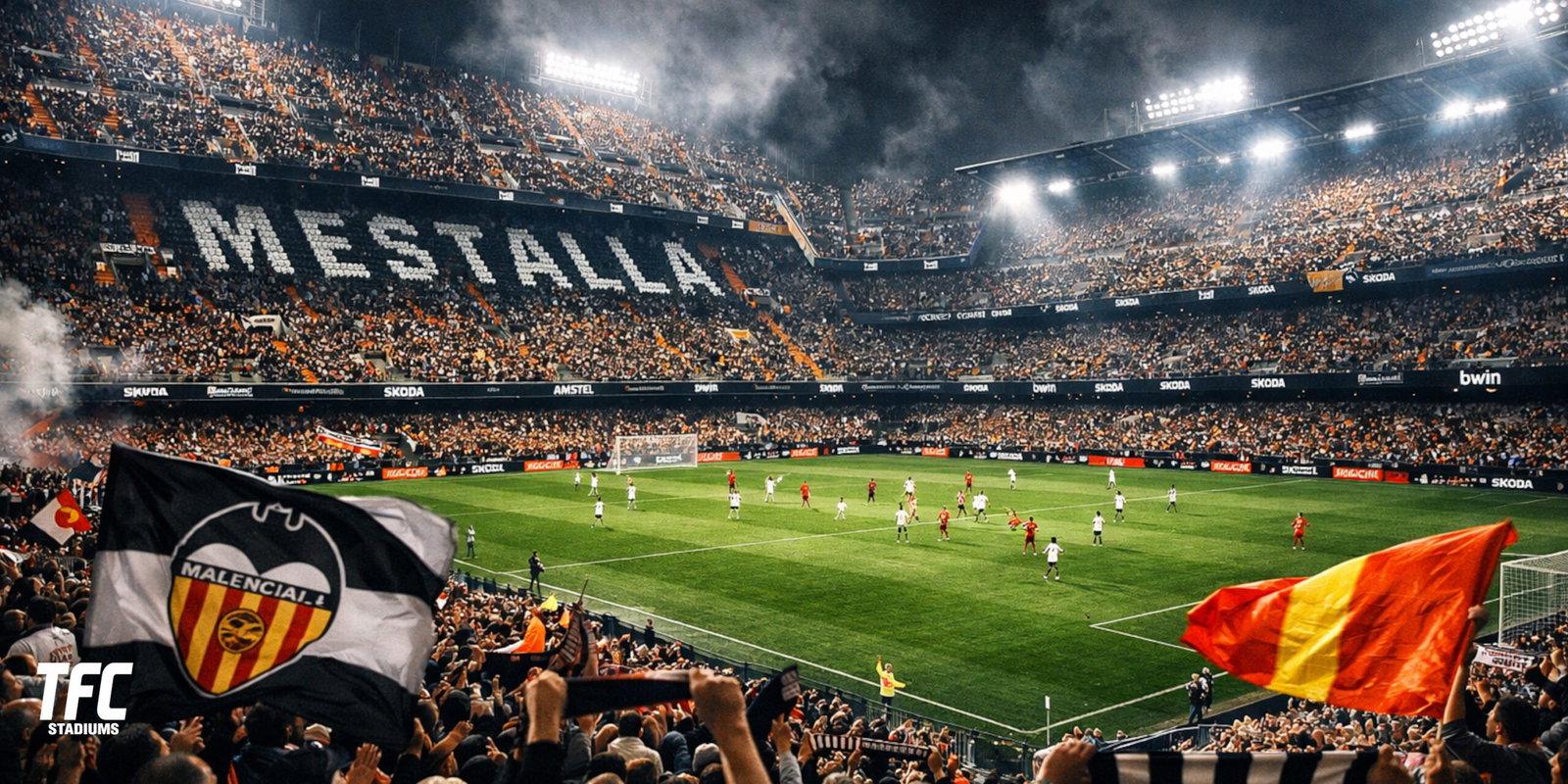
Few stadiums in Spain feel as alive, as tense, or as steeped in history as Mestalla. Home to Valencia CF since 1923, it has witnessed title celebrations, political change, financial turmoil and some of the most dramatic nights in LaLiga history.
It is not the newest ground. It is not the most comfortable. Yet it remains one of the most intimidating and culturally significant venues in Spanish football. If LaLiga has cathedrals, Mestalla is one of them.
Origins and Early LaLiga Years
Mestalla opened in 1923 with a capacity of around 17,000. By the time LaLiga was formally established in 1929, Valencia were already building a reputation as serious contenders.
The stadium expanded rapidly in the 1940s and 1950s despite damage during the Spanish Civil War. Those decades brought Valencia their first league titles, turning Mestalla into a symbol of resurgence and regional pride.
Valencia’s Early League Titles
| Season | Position | Points | Notable Detail |
|---|---|---|---|
| 1941–42 | 1st | 39 | First LaLiga title |
| 1943–44 | 1st | 42 | Dominant attacking record |
| 1946–47 | 1st | 42 | Established as national force |
| 1970–71 | 1st | 44 | Tactical, defence-driven title |
These triumphs cemented Mestalla’s status as more than just a venue. It became a proving ground where the established powers of Madrid and Barcelona were challenged head on.
The Cauldron Effect
Mestalla’s steep stands are its defining feature. The crowd sits almost on top of the pitch, creating a tight and relentless atmosphere. Players often describe it as suffocating in the best possible way.
Unlike many modern arenas designed for hospitality and sightlines first, Mestalla prioritises intensity. Noise does not drift upward. It ricochets.
In tight title races, especially during the 2001–02 and 2003–04 championship seasons, home form proved decisive.
Home Performance in Title Seasons
| Season | Home Wins | Home Goals | League Finish |
|---|---|---|---|
| 2001–02 | 13 | 28 | 1st |
| 2003–04 | 12 | 32 | 1st |
Those Rafael Benítez sides were tactically disciplined, but Mestalla supplied the edge. Visiting teams rarely settled.
Hosting Spain and Major Finals
Mestalla has regularly hosted the Spain national football team. The ground has long been considered a fortress for the national side, with an impressive win record across decades.
It has also staged Copa del Rey finals and high profile European fixtures. During Valencia’s runs to two Champions League finals in the early 2000s, Mestalla became one of the most feared venues in continental football.
While it has never hosted a World Cup final, it remains one of Spain’s most historically important international stadiums.
Rivalries and Identity
The regional rivalry with Villarreal CF carries weight, but clashes with Real Madrid CF and FC Barcelona have shaped LaLiga narratives.
Title races in the early 2000s were not theoretical battles on paper. They were direct, physical, and loud encounters inside Mestalla. Results there often altered the balance of the table.
For Valencia supporters, Mestalla represents more than football. It reflects regional identity within Spain, especially during periods when economic or political tensions ran high. The stadium has been both stage and statement.
Architectural Evolution and Capacity
| Era | Approx Capacity | Key Change |
|---|---|---|
| 1923 | 17,000 | Opening configuration |
| 1950s | 45,000+ | Major expansion |
| 1990s | 55,000 | Modern seating upgrades |
| Current | 49,430 | All-seater adjustments |
While newer venues like the renovated Real Madrid CF home at Santiago Bernabéu boast retractable roofs and screens the size of small villages, Mestalla’s charm lies in its age and proportions.
There have long been plans to replace it with the Nou Mestalla project, yet delays have kept the original ground alive. Many supporters quietly hope it never disappears.
Mestalla in the Modern LaLiga Era
Valencia’s fortunes have fluctuated in recent seasons, yet Mestalla continues to matter.
When Valencia push for European places, the ground becomes volatile again. When they struggle, it becomes demanding. Either way, it influences outcomes.
In an era of global broadcasting and commercial growth, LaLiga still needs stadiums that feel rooted in place. Mestalla provides that contrast to corporate uniformity.
TFC Takeaway
LaLiga history is often told through trophies won by giants. Yet the competition’s character was shaped in grounds like Mestalla, where challengers disrupted the expected order.
It has hosted champions. It has humbled champions. It has endured war, reconstruction, financial strain and generational change.
Modern football moves quickly. Mestalla does not. It stands, slightly worn and stubbornly proud, reminding everyone that atmosphere, history and memory still count for something.
And on certain nights, when the noise rises and the stands tremble, you understand why it remains one of LaLiga’s defining arenas.
About the Author