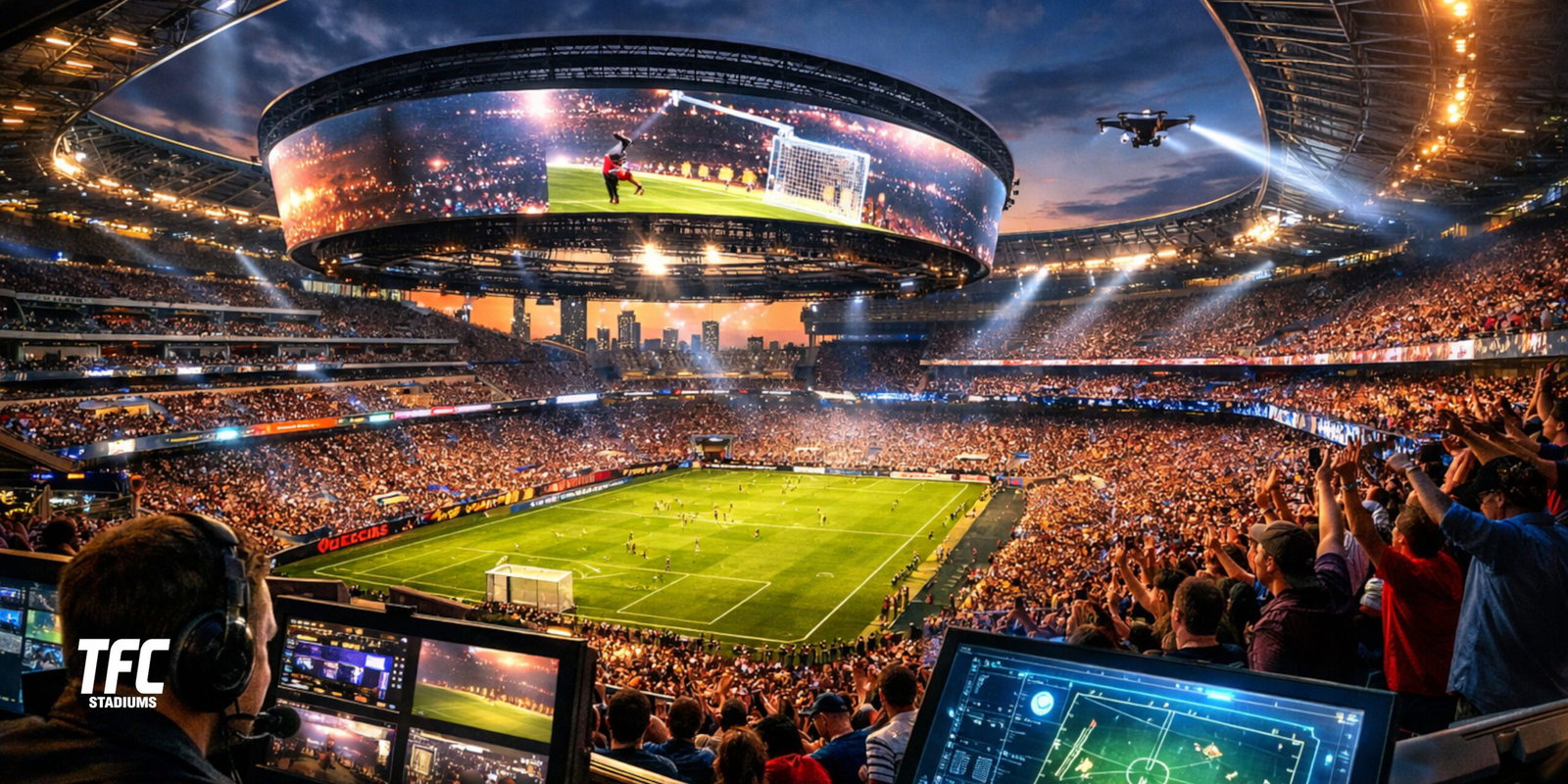
Modern stadiums are no longer just places to watch football, the NFL or concerts. They are giant computers with seats attached. The best now combine private 5G networks, retractable pitches, AI-powered crowd control and enough LED screens to make Times Square look a little shy.
Some stadiums focus on fan experience. Others are obsessed with flexibility, able to host football one night, a concert the next and an NFL game the day after. A few try to do everything at once, usually at the cost of terrifying accountants.
This ranking looks at the most technologically advanced stadiums in the world and, just as importantly, compares what each actually does better than the others.
What Makes a Stadium Truly High Tech
A genuinely advanced stadium does more than install a big screen and call it innovation.
The best modern venues combine several layers of technology:
- High-density Wi‑Fi and private 5G networks that can handle tens of thousands of fans simultaneously
- Retractable roofs and movable pitches that allow different sports and events in the same venue
- Massive LED display systems with live statistics, instant replays and interactive content
- Smart crowd management, using sensors and AI to monitor movement and reduce congestion
- Sustainable systems including solar panels, rainwater recycling and energy-efficient cooling
- Mobile integration for ticketing, wayfinding, food ordering and even finding the shortest queue for a drink
The difference between a good modern stadium and a truly high-tech one is integration. The cleverest venues make all these systems work together, quietly and efficiently, while supporters are mostly busy arguing with the referee.
Santiago Bernabéu Stadium

The rebuilt Santiago Bernabéu is probably the clearest example of a football stadium becoming a giant machine. Real Madrid did not simply renovate the ground. They rebuilt it into a multi-purpose technological fortress.
Its most famous feature is the retractable pitch. The entire playing surface can slide underground into a climate-controlled chamber in sections. This allows the stadium to host concerts and events without destroying the grass, which is a sentence that would have sounded faintly absurd ten years ago.
Other major features include:
- Retractable roof completed in under 15 minutes
- 360-degree LED ribbon screen around the interior
- Real-time crowd density monitoring in concourses
- Advanced climate control for both fans and the pitch
- Multi-event configuration capable of switching from football to concerts rapidly
Bernabéu vs Tottenham Hotspur Stadium
| Feature | Santiago Bernabéu | Tottenham Hotspur Stadium |
|---|---|---|
| Retractable pitch | Yes, stored underground | Yes, slides beneath football surface |
| Roof | Fully retractable | Fixed roof |
| Best use | Football and concerts | Football and NFL |
| Visual technology | 360° LED ring | Extensive ribbon boards and giant screens |
| Flexibility score | Exceptional | Excellent |
The Bernabéu wins for sheer spectacle and versatility. Tottenham is arguably more practical. Madrid built a futuristic theatre. Spurs built a Swiss Army knife with floodlights.
SoFi Stadium
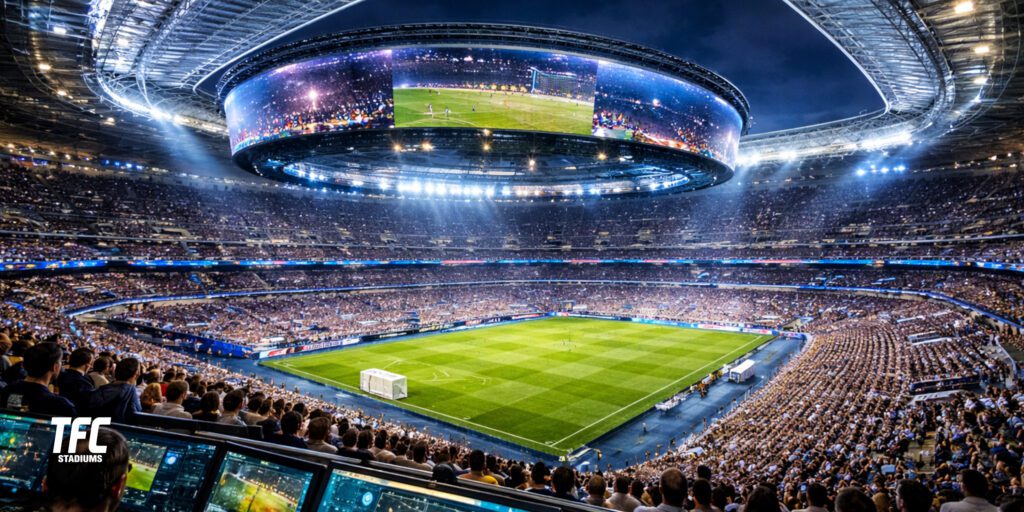
SoFi Stadium in Los Angeles is arguably the most advanced sports venue in North America. It feels less like a stadium and more like somebody gave Silicon Valley an unlimited budget and told it to build something ridiculous.
The centrepiece is the Infinity Screen, the largest double-sided video board in sport. It hangs from the roof and wraps around the field, delivering replays, stats and graphics from every possible angle.
SoFi also has one of the most sophisticated digital infrastructures anywhere:
- More than 2,500 Wi‑Fi access points
- Private 5G network throughout the stadium
- Over 2,600 smaller digital displays
- Real-time mobile ordering and navigation through the app
- Digital twin technology that creates a virtual model of the entire stadium for operations and maintenance
SoFi Stadium vs Allegiant Stadium
| Feature | SoFi Stadium | Allegiant Stadium |
| Main screen | Infinity Screen | Traditional giant video board |
| Connectivity | Private 5G and extensive Wi‑Fi | Wi‑Fi 6 and strong DAS network |
| Roof | Covered, open-air sides | Fully enclosed |
| Crowd capacity | 70,000+ | 65,000+ |
| Best feature | Digital infrastructure | Multi-purpose adaptability |
SoFi is the more ambitious stadium. Allegiant is perhaps the tidier one. SoFi throws every available technology at the visitor. Allegiant chooses its moments more carefully.
Tottenham Hotspur Stadium
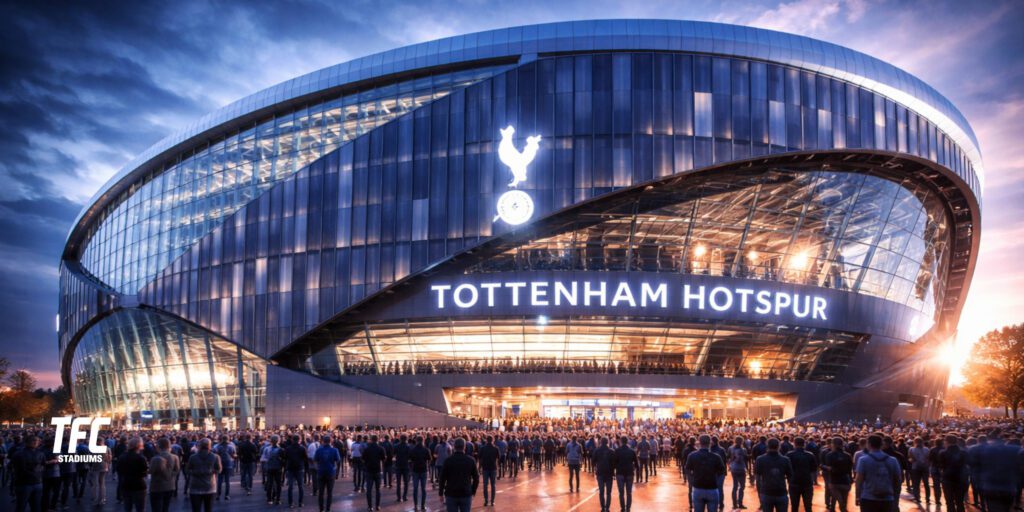
Tottenham Hotspur Stadium is perhaps the smartest football stadium in Britain. It was designed from the start to host both Premier League football and NFL games without compromise.
Its retractable pitch system is remarkable. The natural grass football surface slides away in three enormous sections to reveal a synthetic NFL field underneath. It takes roughly 25 minutes, which is alarmingly quick when you remember this involves moving thousands of tonnes of turf and engineering.
Other standout technology includes:
- More than 1,600 Wi‑Fi access points
- Integrated mobile ordering and digital ticketing
- Advanced acoustics designed to trap and amplify crowd noise
- Built-in television studios and broadcast positions
- The world’s first in-stadium microbrewery, which is technically not advanced technology, but remains one of the finest uses of engineering in modern sport
Tottenham Hotspur Stadium vs Wembley Stadium
| Feature | Tottenham Hotspur Stadium | Wembley Stadium |
| Connectivity | Stronger | Good but older infrastructure |
| NFL readiness | Purpose-built | Adapted |
| Pitch technology | Retractable | Fixed |
| Atmosphere engineering | Superior | More open |
| Overall tech score | Higher | Moderate |
Wembley still feels grander. Tottenham feels smarter.
Mercedes‑Benz Stadium
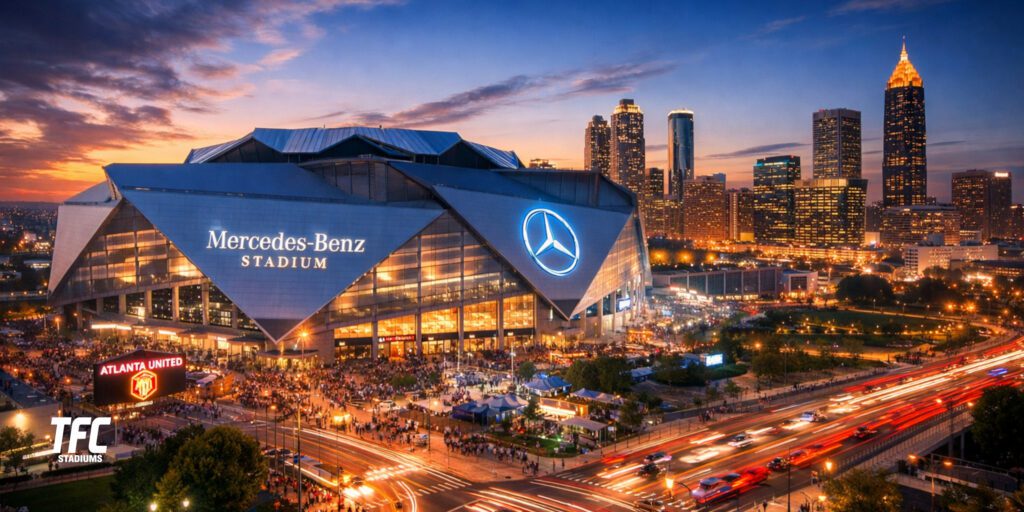
Mercedes-Benz Stadium in Atlanta remains one of the most visually distinctive stadiums in the world. Its retractable roof opens in a pinwheel pattern that looks almost theatrical.
Technologically, it is equally strong:
- 360-degree halo video board
- Advanced cashless payment system
- Smart queue monitoring and concessions tracking
- LEED Platinum sustainability rating
- Energy and water-saving systems integrated throughout the building
Mercedes-Benz Stadium vs SoFi Stadium
| Feature | Mercedes-Benz Stadium | SoFi Stadium |
| Sustainability | Better | Good |
| Screen technology | Halo board | Infinity Screen |
| Roof design | Retractable pinwheel | Covered canopy |
| Fan app integration | Strong | Superior |
Mercedes-Benz is probably the more sustainable stadium. SoFi remains the more technologically overwhelming one.
Allegiant Stadium
The Allianz Arena in Munich is not the newest stadium on this list, but it remains one of the cleverest. Its illuminated ETFE exterior can change colour and patterns, creating one of the most recognisable facades in world sport.
Inside, the stadium has gradually evolved with:
- Smart lighting systems
- Contactless payment and mobile ticketing
- Efficient crowd monitoring
- High-capacity connectivity infrastructure
- Integrated transport and parking systems linked to event demand
Compared with newer American stadiums, Allianz Arena is slightly less extravagant. It is more restrained, more German, and rather efficient about the whole thing.
Lusail Stadium
Built for the 2022 World Cup, Lusail integrated advanced environmental control to manage heat. Pitch cooling and airflow systems work with sensor clusters that adjust output based on real-time temperature and humidity. Digital infrastructure supports cashless concessions and advanced ticketing platforms. As a multi-event venue, its data systems orchestrate staffing, cleaning, and concession deployment based on expected crowd flows.
AT&T Stadium
AT&T Stadium was an early adopter of large-format displays and remains influential. Its centre-hung display integrates live statistics, multiple camera angles, and biometrics into a single presentation layer. Predictive climate control adjusts ventilation and temperature based on attendance counts and weather forecasts. The stadium’s infrastructure is built for adaptability, able to host NFL games, concerts, and esports without heavy reconfiguration.
Allianz Arena
Famous for its lit exterior of 2,874 ETFE panels, Allianz Arena uses a lighting management system that adjusts panel colour and brightness based on event type and ambient conditions. Inside, crowd density monitoring and digital signage coordinate safe and efficient flows. Pitch health systems use embedded probes and climate monitoring to regulate irrigation and under-turf heating in response to data.
Levi’s Stadium
Levi’s Stadium combines high connectivity with digital fan services. A 40 Gbps backbone and distributed antennas provide high-speed Wi-Fi across every seating zone. The official stadium app allows fans to order food, find the shortest restroom line, and view replays on demand. Bluetooth beacons give turn-by-turn navigation inside the venue. Solar panels on the roof feed power back into the grid, and analytics dashboards help operations optimise staffing and services during events.
Technology Comparison Table
| Stadium | Retractable Systems | Connectivity | Sustainability Systems | Data & Analytics |
|---|---|---|---|---|
| Santiago Bernabéu | Roof & pitch | High-density | Moderate | Integrated crowd analytics |
| SoFi Stadium | Roof | Private 5G | Moderate | Fan behaviour & turf sensors |
| Tottenham Hotspur | Pitch | High-density | Low | BMS analytics |
| Mercedes-Benz | Roof | High-density | High | Energy & environmental |
| Allegiant Stadium | No | Wi-Fi 6 | Functional HVAC | Event flow analytics |
| Lusail Stadium | No | Digital ticketing | Climate control | Operations optimisation |
| AT&T Stadium | Roof | High-density | Moderate | Predictive climate |
| Allianz Arena | No | Wi-Fi + 5G | Moderate | Turf & crowd density |
| Levi’s Stadium | No | 40 Gbps Wi-Fi | Solar power | Navigation & app data |
Which Stadium Has the Best Technology?
There is no single winner because each stadium specialises in different areas.
| Category | Best Stadium |
| Best overall technology | SoFi Stadium |
| Best football innovation | Santiago Bernabéu |
| Best multi-sport flexibility | Tottenham Hotspur Stadium |
| Best sustainability | Mercedes-Benz Stadium |
| Best visual design | Allianz Arena |
| Best giant screen system | SoFi Stadium |
| Best retractable pitch | Santiago Bernabéu |
If you want the most futuristic overall experience, SoFi Stadium probably edges it. If you care specifically about football innovation, the Bernabéu is difficult to beat. Tottenham may quietly be the most practical of the lot, which somehow feels very appropriate.
The Future of High-Tech Stadiums
The next generation of stadiums will probably push even further into AI, augmented reality and automation.
Within the next decade we are likely to see:
- AI systems predicting crowd flow before queues even form
- Augmented reality overlays through phones or smart glasses
- Personalised seat-side content based on the supporter’s preferences
- More retractable and modular stadium designs
- Carbon-neutral stadiums with self-sustaining energy systems
The modern stadium is becoming less of a venue and more of a platform. The strange thing is that for all the technology, the best grounds still succeed for the oldest reason imaginable. They make thousands of people lean forward at exactly the same moment.
That part, thankfully, still does not require an app.
About the Author