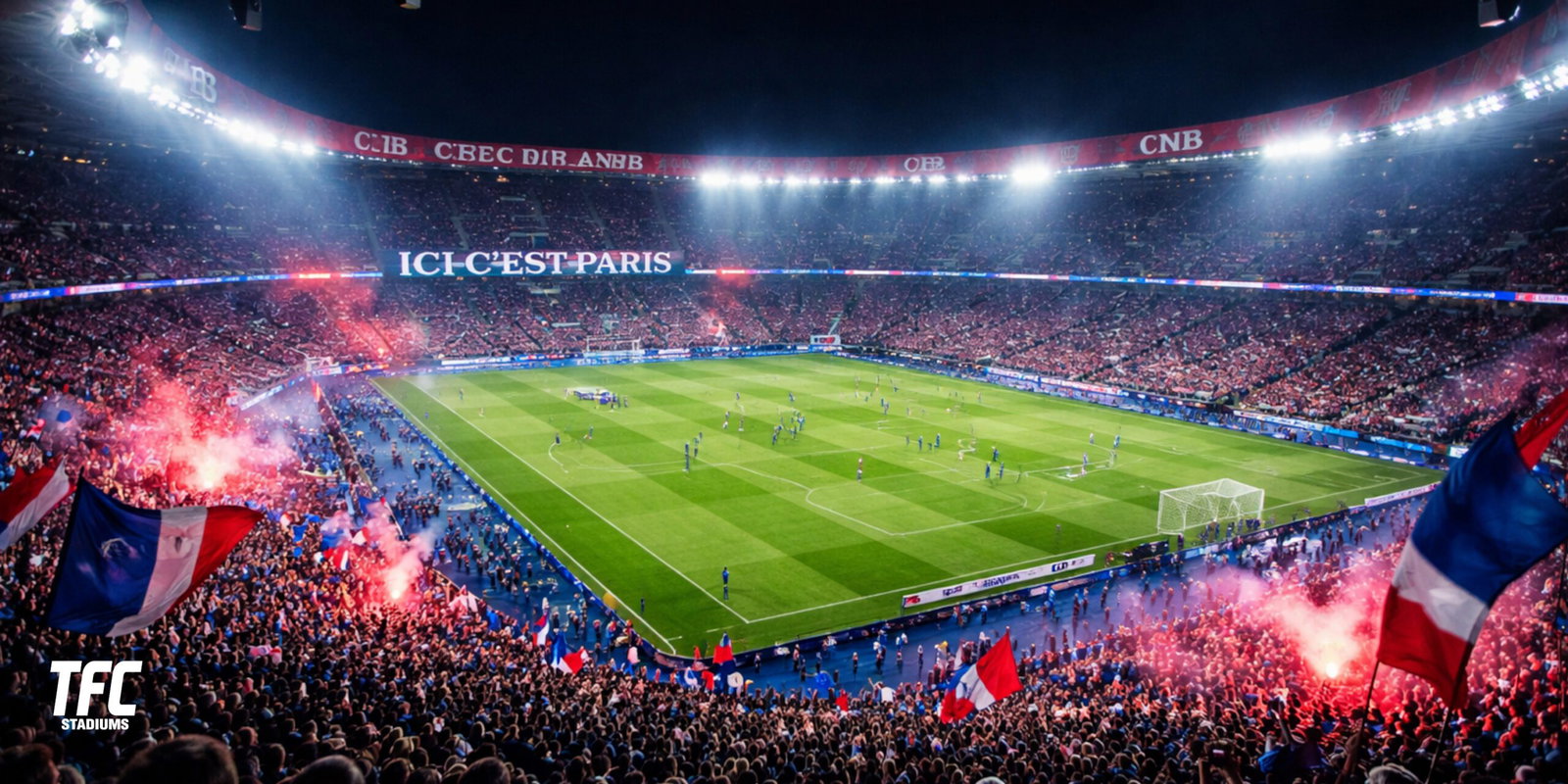
Few stadiums in France carry the weight of expectation quite like Parc des Princes. In the Ligue 1 era, it has transformed from a proud Parisian venue into the beating heart of a global football project. The ground does not simply host matches. It stages statements.
Situated in the 16th arrondissement of Paris, Parc des Princes has been home to Paris Saint-Germain since 1974. Over the past two decades, particularly following new ownership in 2011, it has become synonymous with domestic dominance and European ambition.
Stadium Overview
| Feature | Detail |
|---|---|
| Opened (current structure) | 1972 |
| Architect | Roger Taillibert |
| Capacity | Approx. 47,900 |
| Home Club | Paris Saint-Germain |
| Location | Paris, France |
| Pitch Dimensions | 105 x 68 metres |
The stadium’s concrete ribbed façade gives it a distinctive modernist silhouette. Unlike many European giants, Parc des Princes remains relatively compact. That compactness creates a steep, enclosed atmosphere which amplifies sound and pressure. It is not the largest ground in Ligue 1, yet it often feels the most intense.
PSG’s Rise in the Ligue 1 Era
Paris Saint-Germain have been the defining force of Ligue 1 in the 21st century, particularly after 2011. Titles became routine. Records followed.
Ligue 1 Titles at Parc des Princes
| Season | Position | Points | Notes |
|---|---|---|---|
| 2012–13 | 1st | 83 | First QSI era title |
| 2013–14 | 1st | 89 | Zlatan influence peak |
| 2014–15 | 1st | 83 | Domestic treble |
| 2015–16 | 1st | 96 | Record points tally |
| 2017–18 | 1st | 93 | Mbappé arrival season |
| 2018–19 | 1st | 91 | Neymar era consolidation |
| 2019–20 | 1st | PPG | COVID shortened |
| 2021–22 | 1st | 86 | Messi season |
| 2022–23 | 1st | 85 | Continued dominance |
| 2023–24 | 1st | 76+ | Youth transition phase |
The 2015–16 campaign stands out. Ninety six points. A staggering goal difference. Ligue 1 felt settled by winter. It was dominance bordering on inevitability.
Yet the ground has also seen vulnerability. Monaco’s title in 2016–17 and Lille’s in 2020–21 reminded Paris that domestic control is never entirely secure.
Atmosphere and Support
Parc des Princes has long been shaped by its ultras culture. The Virage Auteuil remains the core of organised support. Choreography, flares, banners and an often uncompromising tone define the matchday experience.
There was a period when tensions between supporters and club management diluted the atmosphere. Since the mid 2010s, there has been a visible effort to restore unity. Big European nights have regained their edge.
In Ligue 1 fixtures, particularly against Marseille and Lyon, the noise level rises sharply. The stadium’s architecture traps sound, creating a pressure cooker effect that visiting teams often comment on.
Key Ligue 1 Matches
Certain matches have defined the Ligue 1 era at Parc des Princes.
Le Classique: PSG vs Marseille
Meetings with Olympique de Marseille remain emotionally charged. The fixture blends sporting rivalry with cultural tension between Paris and the south.
Notable home results include emphatic 3–0 and 4–0 victories during the Zlatan Ibrahimović years. These games often carried title implications and symbolic dominance.
Title Deciders
Several championships have effectively been secured at home. Late season victories in front of packed stands have become part of the club’s rhythm. The celebrations have grown more choreographed, almost expected, yet the Parisian crowd still responds with raw relief.
Goals, Records and Numbers
Parc des Princes has witnessed some extraordinary attacking numbers in Ligue 1.
PSG Ligue 1 Home Record Snapshot
| Era | Avg Goals per Game | Win Percentage | Notable For |
|---|---|---|---|
| 2011–2015 | 2.3 | 72% | Building dominance |
| 2015–2019 | 2.8 | 80% | Peak attacking firepower |
| 2019–2023 | 2.4 | 75% | Star trio era |
| 2023–Present | 2.1 | 70% | Youth integration |
Players such as Zlatan Ibrahimović, Edinson Cavani, Kylian Mbappé and Neymar have each turned the stadium into their personal stage at different times.
Mbappé in particular has reshaped the modern identity of the ground. His pace suits the expansive play PSG often deploy at home. Opposition defenders rarely look comfortable.
Renovations and Modernisation
Although the structure dates from 1972, Parc des Princes has undergone extensive modernisation during the Ligue 1 era.
Upgrades have included:
- Improved hospitality suites
- Expanded media facilities
- LED lighting enhancements
- Enhanced seating comfort
- Digital ticketing infrastructure
There has been ongoing debate about expansion or relocation. The stadium’s capacity lags behind some European giants. However, many supporters argue that increasing size risks losing the intensity that defines it.
For now, Parc des Princes remains both historic and modern. It balances legacy with commercial ambition.
Parc des Princes vs Other Ligue 1 Grounds
| Stadium | Capacity | Club | Atmosphere Profile |
|---|---|---|---|
| Parc des Princes | 47,900 | PSG | Compact, intense, high expectation |
| Orange Vélodrome | 67,000 | Marseille | Vast, passionate, volatile |
| Groupama Stadium | 59,000 | Lyon | Modern, structured, corporate blend |
| Stade Pierre-Mauroy | 50,000 | Lille | Retractable roof, versatile |
While Marseille’s stadium is larger, Parc des Princes often feels sharper, more compressed, more direct. It is built for theatre.
European Ambition and Domestic Reality
The Ligue 1 era at Parc des Princes has been defined by an interesting tension. Domestically, PSG have often looked untouchable. In Europe, the story has been more complicated.
That tension shapes Ligue 1 nights as well. Supporters expect victory. Anything less brings restlessness. A draw can feel like a disappointment. Success has raised the bar to uncomfortable heights.
There is a sense that the stadium itself now carries pressure. It demands spectacle.
Cultural and Commercial Impact
PSG’s rise has transformed Parc des Princes into a global brand location. Shirts worn in Paris are now sold worldwide. Matchday crowds include international visitors alongside lifelong locals.
Broadcast technology and premium hospitality have altered the economics of Ligue 1. Parc des Princes has become central to the league’s global image. For better or worse, it is the face of modern French football.
TFC Takeaway
In the Ligue 1 era, Parc des Princes has evolved from a respected French stadium into a symbol of modern football ambition. It remains relatively intimate, yet it hosts some of the sport’s biggest personalities.
There is always noise in Paris. Sometimes celebratory, sometimes impatient. That tension gives the ground character.
The future may bring expansion or even relocation. For now, under the floodlights, with banners raised and expectations sky high, Parc des Princes continues to define what Ligue 1 looks and feels like at its most ambitious.
About the Author