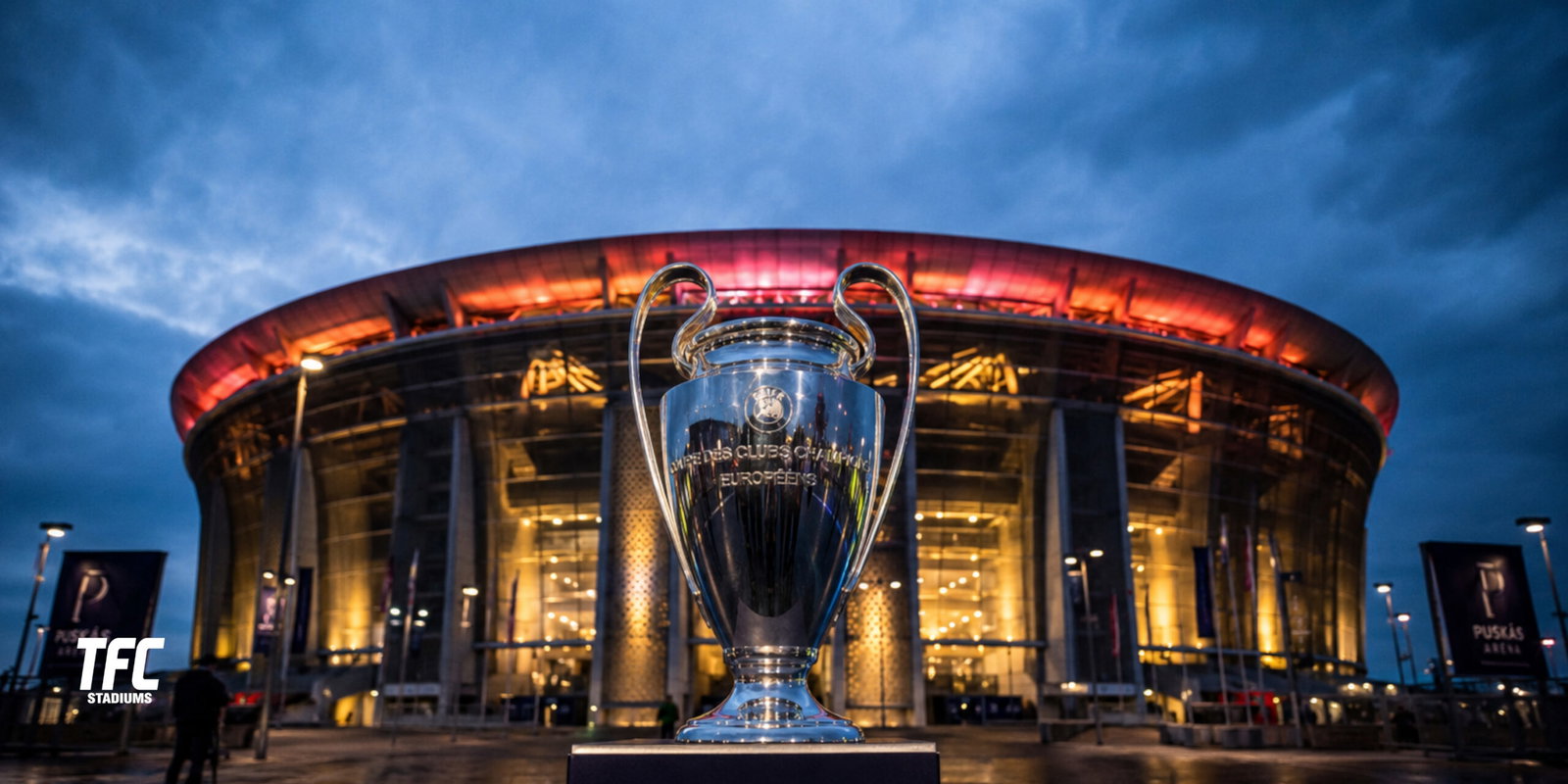
The Stage: Puskás Aréna
Budapest’s crown jewel has quietly become one of Europe’s most reliable big game venues. Opened in 2019 on the site of the old Nepstadion, Puskás Aréna blends modern scale with a nod to Hungarian football heritage.
With a capacity of around 67,000, it hits a sweet spot. Large enough to feel like an occasion, compact enough to keep the noise tight and constant. UEFA has leaned on it heavily in recent years, hosting European finals and neutral venue fixtures when needed. It has built a reputation for smooth logistics, strong sightlines, and a crowd that actually engages rather than politely observing.
For Arsenal and PSG, this is not a neutral ground in the dull sense. It is a venue that amplifies atmosphere.
Stadium Design and Matchday Feel
The design leans heavily into verticality. Steep stands mean supporters sit closer to the pitch than the capacity might suggest. That matters in a final. Every tackle feels louder, every missed chance gets a collective gasp that carries.
Budapest itself adds to the occasion. It is a city that does not rush, but on matchday it hums. Expect packed trams, long café stops, and a steady build rather than a frantic scramble.
Inside the ground, acoustics are sharp. It is the sort of stadium where momentum can swing quickly if one side seizes control early.
Why UEFA Trusts It
UEFA does not hand out finals lightly. Puskás Aréna has become a go to option because it avoids the usual headaches.
- Modern infrastructure, no bottlenecks getting in or out
- Central European location, accessible for travelling supporters
- Proven track record with high profile fixtures
It has already hosted major European finals and international matches under pressure conditions. That counts for a lot when everything from security to broadcasting needs to run without friction.
Arsenal Form Guide
Arsenal arrive with momentum and, more importantly, belief. This is a side that has matured over the past few seasons into something far more resilient than its earlier iterations.
Recent form across all competitions has been strong, built on:
- Controlled possession, often above 55 percent
- A defensive pairing that rarely loses shape under pressure
- Wide threats that stretch games rather than forcing them
Key players like Bukayo Saka and Martin Ødegaard have added consistency to flair. Arsenal no longer rely on moments. They build pressure, sustain it, and wait for mistakes.
Their Champions League run has shown a pragmatic edge. Knockout ties have been managed rather than chased, which is often what separates finalists from nearly teams.
PSG Form Guide
Paris Saint Germain remain one of the most dangerous attacking sides in Europe. They arrive with a slightly different identity, less chaotic, more structured, though still capable of sudden bursts that can flip a match.
Their recent form suggests:
- High scoring output, especially in transition
- Improved midfield balance compared to previous seasons
- Occasional defensive lapses when pressed aggressively
Ousmane Dembélé remains the obvious game-changer. Give him space and the game changes. Deny him space and PSG are forced into longer spells of patient build up, which is not always their comfort zone.
The difference this season has been control. PSG are not just relying on talent, they are managing games better.
Previous Meetings: Arsenal vs PSG
These two are not strangers, though meetings have been relatively rare at this level.
Head to head history shows a balanced record:
- Champions League group stage clashes in 2016 ended in two draws
- Arsenal edged the group on goal difference
- Both matches were tight, controlled, and low scoring
Those games hinted at stylistic tension. Arsenal preferred structured buildup. PSG leaned into pace and individual brilliance. That contrast still exists, though both sides have evolved.
The lack of recent knockout history adds intrigue. There is no psychological baggage from past eliminations, just familiarity without resentment.
Tactical Battle to Watch
This final is likely to hinge on control versus transition.
Arsenal will try to dictate tempo through midfield, using Ødegaard as the conductor. If they succeed, PSG will be pinned deeper than they prefer.
PSG will look for moments rather than dominance. Quick turnovers, direct runs, and isolating defenders in space. If Ousmane Dembélé gets repeated one on one situations, Arsenal’s structure will be tested in ways it does not always face domestically.
Set pieces could also be decisive. Finals often turn on small margins, and both sides have shown they can capitalise in those moments.
What Could Decide the Final
A few factors stand out:
- First goal impact, Puskás Aréna amplifies momentum shifts
- Midfield discipline, losing shape for even five minutes could be costly
- Game management late on, especially if it stays level into the final stages
Arsenal may edge possession. PSG may edge raw threat. Finals rarely reward the more entertaining side. They reward the side that handles pressure without blinking.
TFC Takeaway
Puskás Aréna feels like the right stage for this kind of matchup. Modern, loud, and unforgiving if you lose focus for even a moment.
Arsenal arrive looking complete. PSG arrive looking dangerous. That is usually a good recipe for a final that does not drift.
It might not be a classic for flowing football, but it has all the ingredients for a tense, high quality contest where one moment defines everything.
About the Author