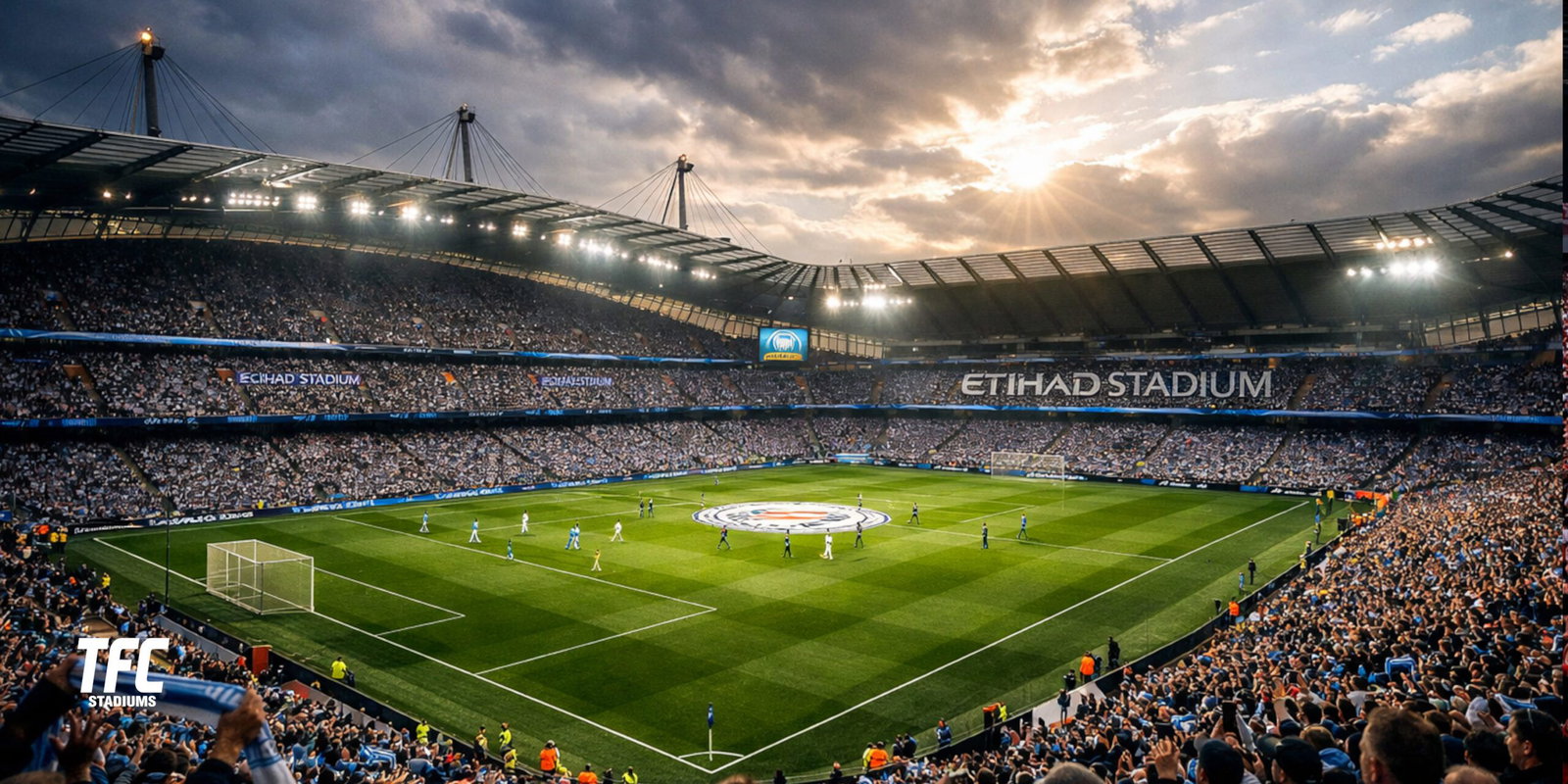
Modern football stadiums are rarely simple construction projects. They are usually statements of ambition, identity, and sometimes sheer stubbornness. Manchester City’s home is a good example. What began life as an athletics stadium built for the 2002 Commonwealth Games is now the Etihad Stadium, one of the most recognisable grounds in English football.
The conversion from track and field venue to Premier League fortress was not quick, cheap, or straightforward. Yet it stands as one of the more successful stadium transformations in modern sport. What could easily have become an awkward multi-purpose arena instead became a purpose-built football venue that now sits at the centre of one of the largest sporting campuses in Europe.
The Commonwealth Games Origins
The stadium opened in 2002 as the City of Manchester Stadium, built to host the athletics events of the Commonwealth Games in Manchester. At that stage it looked exactly what it was: an athletics venue with a running track and seating set well back from the field.
Key details of the original stadium:
| Feature | Details |
|---|---|
| Opening Year | 2002 |
| Original Purpose | Commonwealth Games athletics |
| Capacity (2002) | About 38,000 |
| Owner | Manchester City Council |
| Construction Cost | Approx £110 million |
| Architect | Arup Associates |
The design always included a second life after the Games. Unlike many Olympic venues that struggle for relevance once the closing ceremony ends, Manchester planned from the start to convert the stadium into a football ground.
That foresight mattered.
Without it, the stadium could easily have become another large but rarely used athletics facility.
Manchester City’s Move from Maine Road
For decades Manchester City played at Maine Road, a ground with enormous history but increasingly obvious limitations. Built in 1923, it struggled to keep pace with modern stadium requirements.
By the early 2000s the club faced several problems:
- Limited expansion potential
- Ageing infrastructure
- Lower corporate revenue compared to rivals
- Reduced matchday facilities
Moving into a new stadium offered a rare opportunity. Instead of building entirely from scratch, the club and the city agreed to convert the Commonwealth Games venue once the athletics event had finished.
The agreement created a partnership model where Manchester City would lease the stadium while the city retained ownership.
The Conversion Process
The transformation from athletics arena to football stadium took place between 2002 and 2003. The changes were extensive.
The most obvious issue was the running track. Football stadiums thrive on intimacy. Supporters want to feel close enough to the pitch to shout instructions, or at least complain convincingly.
Athletics tracks ruin that.
Engineers solved the problem by lowering the playing surface by several metres. This allowed new seating tiers to be constructed closer to the pitch, removing the huge gap that usually plagues athletics conversions.
Major conversion changes included:
- Lowering the pitch by roughly six metres
- Removing the running track entirely
- Adding a new lower seating tier around the pitch
- Expanding the capacity to around 48,000
- Reconfiguring entrances and concourses
The end result felt far more like a purpose built football ground than a recycled athletics stadium.
Architecture and Design
The stadium’s most distinctive feature is its sweeping cable-supported roof. Tall masts support the structure from above, creating the curved silhouette visible across east Manchester.
Architecturally, the design balances openness with scale. Large open concourses allow supporters to move easily around the ground, while the bowl shape keeps fans relatively close to the action.
Key architectural features include:
- A tension ring roof supported by twelve masts
- Continuous bowl seating design
- Large external plazas for crowd flow
- Transparent concourse spaces that allow natural light
It is also a stadium that has grown. Since Manchester City’s takeover in 2008, the ground has been expanded with additional tiers and improved facilities.
Capacity today exceeds 53,000.
Head to Head with Other Converted Stadiums
Converting athletics stadiums into football venues has a mixed record. Some work well. Others remain slightly awkward compromises.
Comparing Manchester City’s stadium with other examples shows why its design is often praised.
| Stadium | Original Use | Current Capacity | Conversion Success |
|---|---|---|---|
| Etihad Stadium (Manchester) | Commonwealth Games athletics | 53,000+ | Very successful |
| London Stadium | 2012 Olympics | 62,500 | Mixed reception |
| Olympic Stadium (Rome) | Athletics and football | 70,000 | Multi-use compromise |
| Stade de France | Athletics and football | 80,000 | Primarily national events |
The key difference lies in how aggressively Manchester redesigned the seating bowl. By lowering the pitch and building new tiers, the stadium avoided the distant viewing angles that plague many converted arenas.
Fans sit closer to the action than they do in several stadiums that were originally designed for football.
Atmosphere and Matchday Experience
Atmosphere in modern stadiums is often debated with almost scholarly seriousness. Some insist new venues feel sterile. Others argue that success quickly cures nostalgia.
At the Etihad, the atmosphere has evolved alongside the club’s fortunes.
Early years after the move produced respectable crowds but modest noise levels. The stadium was comfortable but lacked the edge of Maine Road.
The rise of Manchester City under new ownership changed that.
Champions League nights, title races, and intense rivalries have filled the stadium with energy. The South Stand expansion helped concentrate some of the loudest supporters into a single end.
The result is a ground that now produces some of the Premier League’s most dramatic matchday moments.
Impact on Manchester City’s Growth
The stadium conversion happened just before one of the most dramatic transformations in football.
In 2008 the club was purchased by the Abu Dhabi United Group. Investment soon followed, both on the pitch and around the stadium itself.
The Etihad Campus now includes:
- Training facilities for the men’s and women’s teams
- The City Football Academy
- Youth development facilities
- Community pitches
- Commercial and hospitality areas
The stadium sits at the centre of this wider sporting district. It has become both a football venue and a symbol of the club’s rise.
TFC Takeaway
Turning an athletics stadium into a football ground rarely produces perfect results. Too often the compromises are obvious, and supporters feel detached from the action.
Manchester City’s conversion avoided most of those pitfalls.
Lowering the pitch, rebuilding the seating bowl, and expanding the ground over time created something that feels purpose built rather than repurposed. It also arrived at the right moment. Just a few years later, the club would enter the most successful era in its history.
Sometimes timing matters as much as architecture.
Manchester City did not simply move into a new stadium. They inherited a blank canvas and quietly reshaped it into a modern football landmark.
About the Author