SoFi Stadium does not ease you into its technology. It throws it straight at you, in high resolution, from every possible angle. The interactive screens are not background decoration or polite add-ons. They sit at the heart of how the stadium works, how fans move through it, and how games are consumed in person.
This is a venue built for the screen age, but one that still understands it is meant to serve live sport, not compete with it.
The Infinity Screen, the Centrepiece
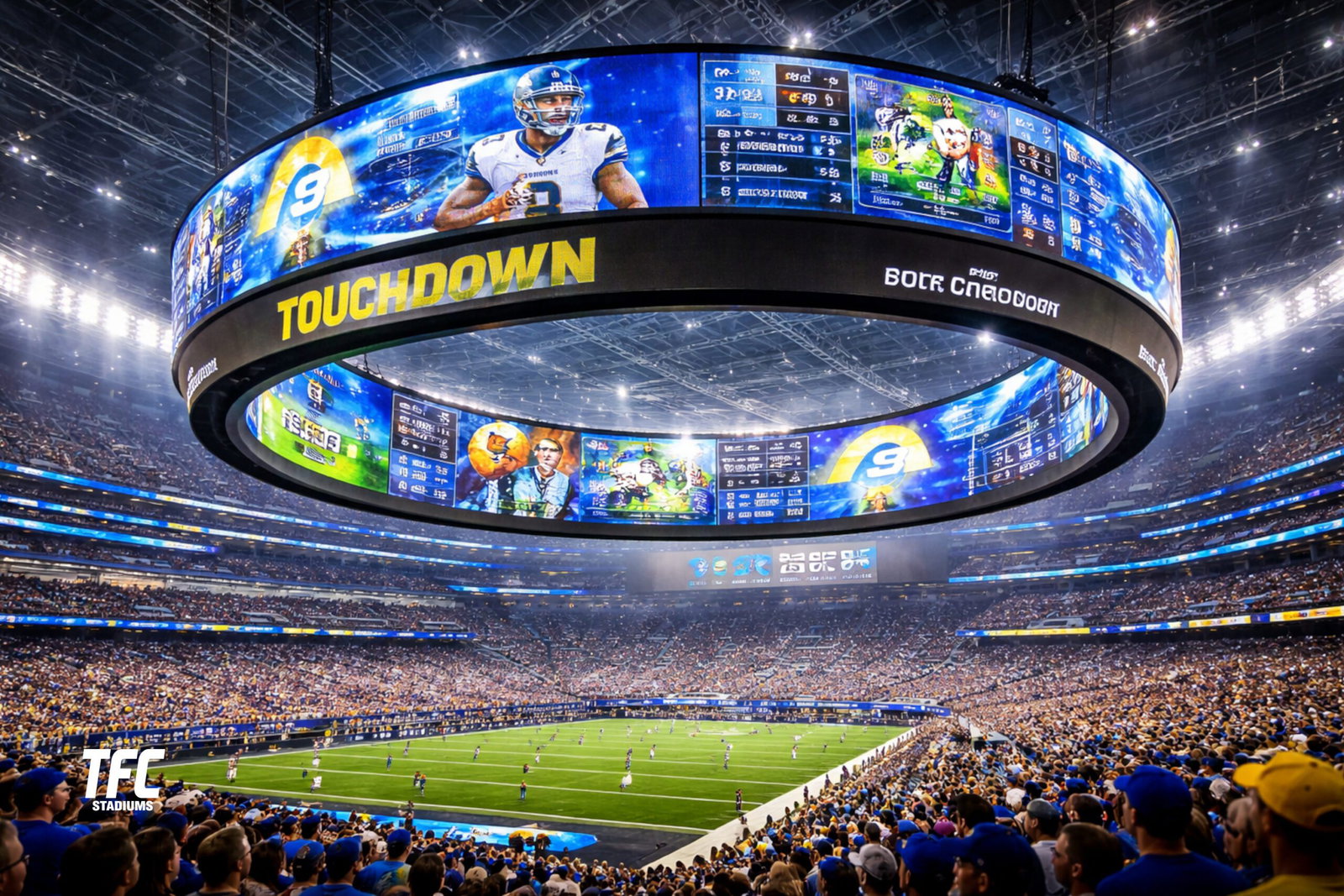
The defining feature is the Infinity Screen, a dual sided 4K HDR video board suspended above the field. It wraps around the stadium in an oval, hovering just below the roof, and it is impossible to ignore.
What makes it different is not just scale, though it is enormous. It is the way content flows across it. Live action, replays, stats, crowd prompts, sponsor visuals, and social content all rotate in real time. Fans in any seat get a clear view, which quietly solves a problem that has haunted older NFL stadiums for decades.
You are not craning your neck or checking your phone to see what just happened. The screen does the work for you, and does it without pulling your attention away from the field for long.
Concourse Screens and Wayfinding
Away from the seating bowl, screens line the concourses and entry points. These are not static advertising boards. They act as wayfinding tools, live game monitors, and information hubs.
You can walk the full loop of the stadium, grab food, check queue times, and still follow the game without feeling disconnected. For casual fans, this matters more than it sounds. It keeps energy levels up and stops the stadium from feeling like two separate experiences, one inside the bowl and one outside it.
There is also a subtle design choice here. The screens are integrated cleanly into the architecture. They feel intentional rather than bolted on, which is where many modern venues fall short.
Mobile Integration and Fan Control
The screens are tied closely to the stadium app ecosystem. Fans can interact indirectly through polls, prompts, and live content cues. Crowd noise meters, reaction visuals, and fan cams often pull data or participation from mobile users.
It is interactive in a loose, friction free way. You are not forced to scan QR codes every five minutes or play gimmicky games. Participation is optional, lightweight, and mostly fun.
This balance matters. The tech enhances atmosphere rather than hijacking it.
Premium Areas and Personalised Viewing
In suites, clubs, and lounges, screens shift tone. Here they become tools of control. Multiple feeds, custom camera angles, real time stats, and live broadcasts run alongside the in stadium experience.
This is where SoFi leans into its luxury brief. Premium ticket holders are not just watching the same feed on a bigger television. They are getting choice, flexibility, and a level of control that mirrors high end home setups, only with 70,000 people roaring outside the glass.
Advertising That Knows When to Behave
One of the quiet successes of SoFi’s screen strategy is restraint. Yes, there is a lot of advertising. That is inevitable. What is notable is how rarely it feels intrusive.
Ads are woven into transitions, breaks, and secondary spaces rather than overwhelming live play. The Infinity Screen, in particular, prioritises the game first. When it cuts to sponsor content, it does so with pace and clarity, then gets out of the way.
That sounds like a small thing. It is not.
A Stadium Designed for How Fans Actually Watch Sport
SoFi Stadium understands a simple truth. Modern fans watch sport with layers of information. Replays, stats, angles, context. The interactive screens provide those layers without forcing people to leave the live moment.
It feels less like watching a game inside a giant television and more like the stadium itself has learned how fans think.
Not every venue needs this level of screen saturation. But for a stadium positioning itself as the future of live sport, SoFi largely gets it right.
About the Author