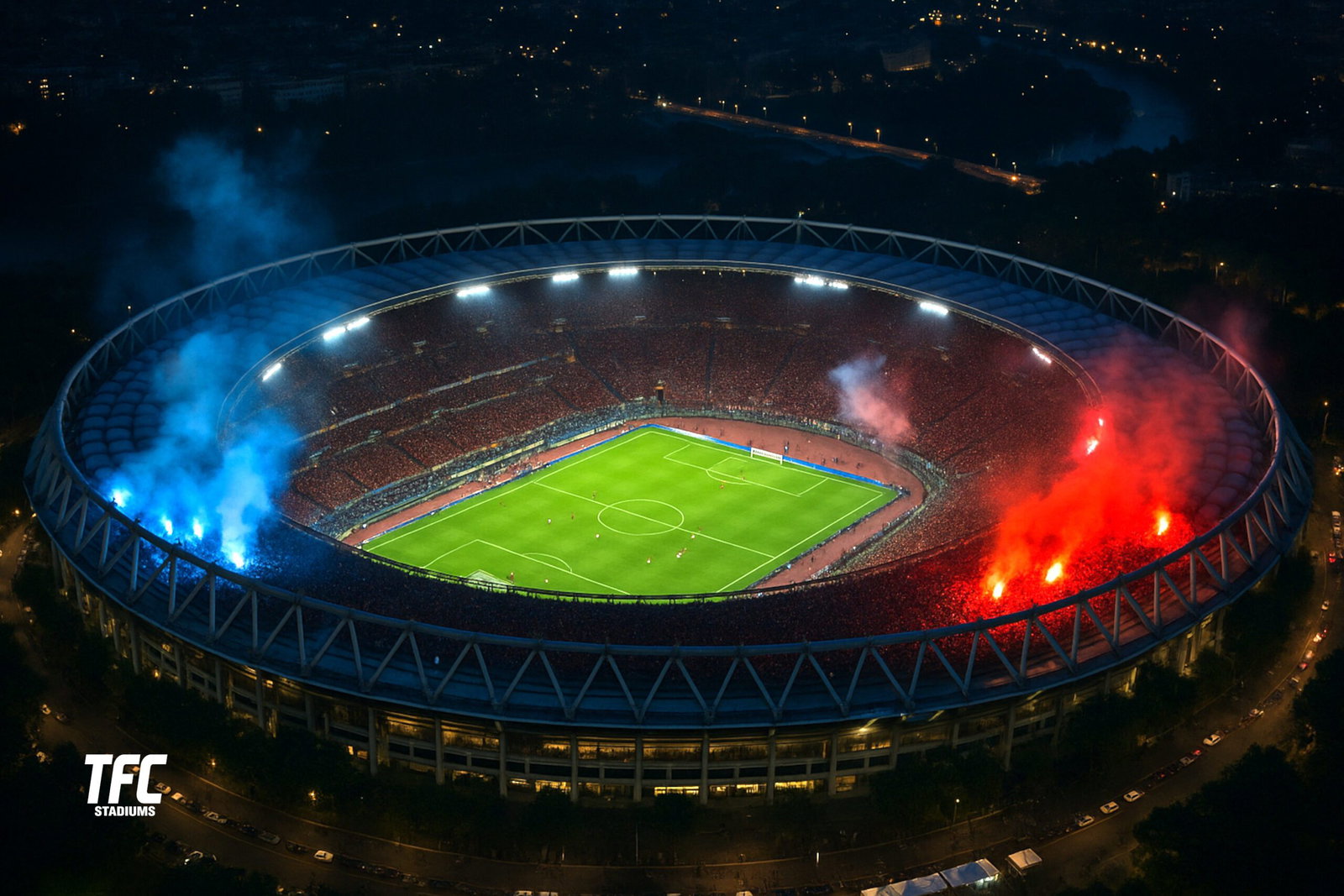
Few stadiums embody the drama of football like the Stadio Olimpico. Set in the heart of Rome’s sporting complex, the stadium is more than a structure of concrete and steel. It is a living monument to Italy’s passion, resilience, and artistry in the game. Home to both AS Roma and SS Lazio, it has hosted fierce derbies, European finals, and World Cup triumphs.
Origins and Architecture
Built initially for the 1960 Olympics, the Stadio Olimpico has evolved through multiple renovations, each adding layers to its story. Designed with classical grandeur in mind, its elliptical form mirrors ancient Roman amphitheatres. The 1990 World Cup brought its most significant upgrade, introducing a modernised roof canopy that still defines its silhouette today.
- Opened: 1953 (as Stadio dei Cipressi, later renamed Stadio Olimpico)
- Capacity: Approx. 70,000
- Major renovations: 1990, 2008
- Architectural style: Functional modernism with neoclassical echoes
The venue’s open design allows the roar of supporters to rise into the night air, often blending with the hum of the city beyond the Tiber.
Historic Matches and Legendary Moments
The Stadio Olimpico has staged some of the greatest matches in football history. The 1990 World Cup final between West Germany and Argentina was a masterclass in tension, decided by Andreas Brehme’s late penalty. Decades earlier, the stadium had hosted Italy’s emotional run to victory in the 1968 European Championship.
European club football has also left its mark here. Liverpool’s 1984 European Cup win on penalties against Roma remains one of the sport’s cruelest finales, while Barcelona’s triumph over Manchester United in the 2009 Champions League final showcased a new era of dominance.
Notable matches:
- Italy vs Yugoslavia, Euro 1968 final
- West Germany vs Argentina, World Cup 1990 final
- Roma vs Liverpool, European Cup final 1984
- Barcelona vs Manchester United, Champions League final 2009
The Derby della Capitale
No fixture defines the stadium’s pulse more than the Derby della Capitale. When Roma and Lazio clash, the Olimpico transforms into a cauldron of smoke, song, and colour. Choreographies stretch across the Curva Sud and Curva Nord, where loyalty is inherited rather than chosen.
The atmosphere is electric but deeply Roman in character: passionate, creative, and occasionally combustible. For many locals, the derby is not just a match but a civic ritual that defines identity and pride.
Beyond Club Football
The Olimpico’s stage extends far beyond Serie A. It remains a central venue for the Italian national team, hosting countless qualifiers and friendlies under the floodlights. It was also chosen as a key host for Euro 2020, where Italy began their victorious campaign with a 3–0 win over Turkey.
The stadium’s versatility also makes it a stage for music and culture, welcoming artists from Springsteen to U2, proving that the emotion it holds transcends sport.
Visiting the Stadio Olimpico
Nestled within the Foro Italico complex, visitors can reach the stadium via tram or on foot from the Ponte Duca d’Aosta. The surrounding area offers leafy boulevards, classical statues, and a glimpse of Mussolini-era architecture. Inside, the seating is steep and close enough to the pitch to capture every moment of intensity.
Tips for visitors:
- Best atmosphere: Roma vs Lazio or any European night
- Tour experience: Behind-the-scenes tours available year-round
- Nearby attractions: Foro Italico, Ponte Milvio, MAXXI Museum
Legacy and Lore
The Stadio Olimpico stands as Italy’s footballing heart, as synonymous with passion as Wembley is with ceremony or the Maracanã with mystique. It bridges eras, hosting the disciplined tactics of Italy’s past and the expressive play of modern football.
In a city built upon ruins and renaissance, the Olimpico endures as both monument and battleground. Every goal, every chant, every heartbreak adds another line to its mythology.
About the Author