Stadiums are no longer built solely for function. Many modern and historic venues reflect architectural ambition, cultural identity, and engineering breakthroughs. From glowing façades to movable pitches, these structures stand as landmarks in their own right. Here are 15 stadiums that showcase unique architecture across the world.
1. Allianz Arena, Munich
- Opened: 2005
- Capacity: 75,000
- Construction Cost: €340 million
- Architects: Herzog & de Meuron
The Allianz Arena is famous for its exterior of inflated ETFE panels, which light up in red, blue, or white depending on the team. Its design gives Munich one of the most recognisable silhouettes in world football.
2. Bird’s Nest (Beijing National Stadium), Beijing
- Opened: 2008
- Capacity: 80,000 (originally 91,000)
- Construction Cost: $428 million
- Architects: Herzog & de Meuron with Ai Weiwei
Built for the 2008 Olympics, the Bird’s Nest features a lattice of steel beams resembling a woven nest. It combines symbolic artistry with bold structural innovation, cementing itself as a global icon.
3. Wembley Stadium, London
- Opened: 2007
- Capacity: 90,000
- Construction Cost: £798 million
- Architects: Foster + Partners and Populous
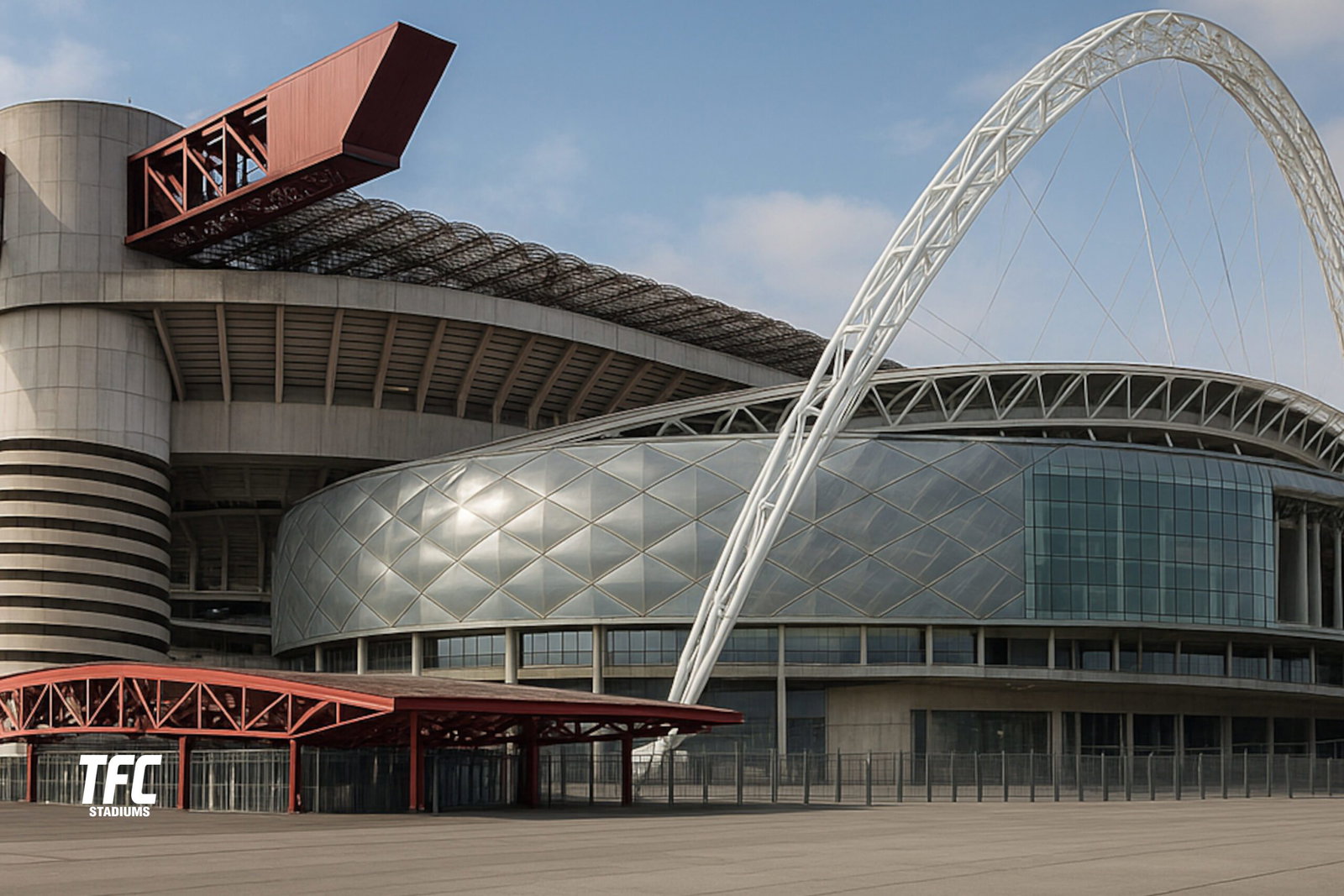
The rebuilt Wembley incorporates a 133-metre-high arch that supports much of the roof. Both practical and symbolic, the arch ensures clear sightlines and a defining skyline presence.
4. FNB Stadium (Soccer City), Johannesburg
- Opened: 1989, renovated in 2009
- Capacity: 94,736
- Renovation Cost: $440 million
- Architects: Boogertman + Partners
Resembling an African calabash, FNB Stadium’s earth-toned cladding reflects South African heritage. It hosted both the opening and final of the 2010 FIFA World Cup, highlighting its global importance.
5. MetLife Stadium, New Jersey
- Opened: 2010
- Capacity: 82,500
- Construction Cost: $1.6 billion
- Architects: 360 Architecture, EwingCole, Rockwell Group
Home to both the Giants and Jets, MetLife Stadium uses a façade of aluminium louvers with LED lighting. The exterior can change colour to reflect the home team, a unique touch in American sport.
6. San Siro, Milan
- Opened: 1926, expanded 1990
- Capacity: 75,923
- Architects: Ulisse Stacchini, Armando Ronca, Giancarlo Ragazzi
San Siro’s cylindrical towers and red steel roof trusses give it a fortress-like appearance. Its raw, industrial design is iconic in European football, making it one of the sport’s cathedrals.
7. Sapporo Dome, Japan
- Opened: 2001
- Capacity: 41,484 (football), 42,122 (baseball)
- Construction Cost: $426 million
- Architects: Hiroshi Hara and Associates
The Sapporo Dome features a sliding pitch system, allowing the natural grass football field to roll outside for sunlight. This versatility makes it one of the most technically advanced stadiums in the world.
8. AT&T Stadium, Arlington
- Opened: 2009
- Capacity: 80,000 (expandable to 105,000)
- Construction Cost: $1.3 billion
- Architects: HKS, Inc.
AT&T Stadium’s retractable roof and monumental glass façades create a sense of openness. Inside, one of the largest HD video boards ever built dominates the interior, redefining the stadium experience.
9. Lusail Stadium, Qatar
- Opened: 2021
- Capacity: 88,966
- Construction Cost: $767 million
- Architects: Foster + Partners and Populous
Built for the 2022 FIFA World Cup final, Lusail Stadium’s golden bowl design draws inspiration from traditional Arab lanterns and ceramic vessels. Its symmetry and scale make it Qatar’s premier sporting venue.
10. Arena da Amazônia, Manaus
- Opened: 2014
- Capacity: 44,310
- Construction Cost: $300 million
- Architects: Gerkan, Marg and Partners (GMP)
Located deep in the Amazon rainforest, this stadium was designed to resemble a woven basket. The white lattice roof provides shade and ventilation in the tropical climate, making it a striking cultural statement.
11. Estadio Azteca, Mexico City
- Opened: 1966
- Capacity: 87,523
- Architects: Pedro Ramírez Vázquez and Rafael Mijares Alcérreca
The Estadio Azteca is not only historic but architecturally unique for its vast bowl-like structure carved into a hillside. Its monumental scale has made it the stage for two FIFA World Cup finals.
12. Mercedes-Benz Stadium, Atlanta
- Opened: 2017
- Capacity: 71,000 (expandable to 75,000)
- Construction Cost: $1.6 billion
- Architects: HOK
Known for its retractable “oculus” roof that opens like a camera lens, Mercedes-Benz Stadium blends futuristic engineering with sustainability. It also houses one of the largest video boards in sport, wrapping 360 degrees around the roof.
13. Estádio Municipal de Braga, Portugal
- Opened: 2003
- Capacity: 30,286
- Construction Cost: €83 million
- Architects: Eduardo Souto de Moura
Built into the side of a quarry, the Braga Municipal Stadium has only two stands, with one side facing exposed rock. Its dramatic natural integration makes it one of the most unusual stadiums in Europe.
14. Singapore National Stadium
- Opened: 2014
- Capacity: 55,000
- Construction Cost: $1.3 billion
- Architects: Arup, DP Architects, AECOM
The Singapore National Stadium has the world’s largest free-spanning dome roof, stretching 310 metres. Its retractable roof and adjustable seating bowl allow it to host multiple sports and major concerts.
15. Maracanã, Rio de Janeiro
- Opened: 1950, renovated in 2014
- Capacity: 78,838
- Construction Cost: $500 million (renovation)
- Architects: Miguel Feldman, Waldir Ramos, Raphael Galvão
The Maracanã was once the largest stadium in the world, hosting nearly 200,000 people for the 1950 World Cup final. Its circular design and historical importance make it an enduring architectural and cultural landmark.
Legacy of Architectural Innovation
These 15 stadiums prove that architecture can elevate sport beyond function. Each combines cultural symbolism, technical precision, and visual spectacle. From ancient-inspired designs like Lusail’s golden bowl to modern feats like Mercedes-Benz Stadium’s oculus roof, they show how arenas can stand as monuments to creativity as much as to competition.
About the Author