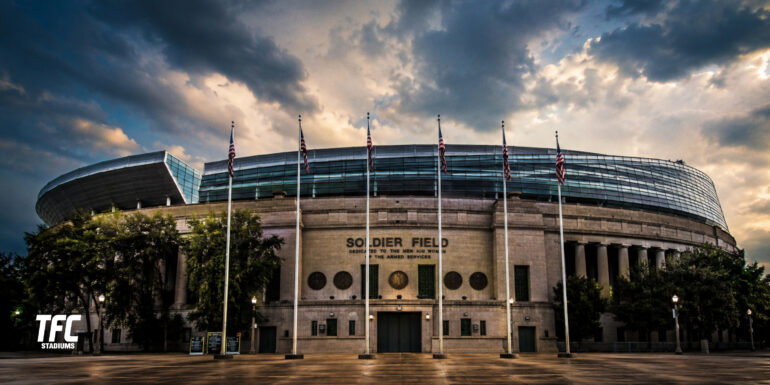

Most stadiums follow familiar patterns. A symmetrical bowl, clear sightlines, and modern materials define the standard. Yet a handful of venues stand out for their sheer eccentricity. From oddly shaped roofs to asymmetrical stands and unexpected geometry, these stadiums prove that sometimes, breaking design convention can make a place unforgettable.
Estádio Municipal de Braga, Portugal
Carved directly into the face of a granite quarry, Braga’s home ground is a marvel of brutalist ingenuity. Built for Euro 2004, it features only two stands facing each other across the pitch, with one end opening onto the rock face and the other to a sweeping view of the city. The roof is suspended by steel cables strung between the stands, resembling a bridge more than a stadium. It feels more like an amphitheatre than a football arena.
The Float @ Marina Bay, Singapore
Technically, it floats. The Float is a temporary structure built on a pontoon in Marina Bay, with the city skyline rising behind it. Designed to host national events and sports, it’s the only full-sized floating stadium in the world. The backdrop of skyscrapers and water reflections creates an almost surreal setting, especially at night when the surface shimmers under floodlights.
The Olympic Stadium, Montreal, Canada
Montreal’s Olympic Stadium might be more famous for its engineering challenges than its successes, but there’s no denying its shape is remarkable. Nicknamed “The Big O” for its circular form, it also has a leaning tower and retractable roof that once promised futuristic flexibility. Despite its flaws and cost overruns, the structure remains one of the most visually striking arenas in North America.
Henningsvær Stadium, Norway
Built on a rocky island in the Lofoten archipelago, this small football pitch looks like it belongs in a fantasy landscape. There are no stands, only gravel paths and cliffs surrounding the field. What makes it truly unique is the setting: green turf surrounded by the North Sea and sharp mountain peaks. It’s more art installation than stadium, a place where the game feels secondary to the view.
Stadion Gospin Dolac, Croatia
Gospin Dolac in Imotski sits dramatically beside a cliff overlooking a deep blue sinkhole lake. The stone terraces and jagged terrain make it one of Europe’s most scenic football grounds. The shape of the land dictates everything, giving the stadium a rough-edged, irregular layout that feels carved by nature rather than designed by engineers.
Eye of the Emirates Wheel Stadium Concept, UAE
Still a concept, but worth mentioning. Proposed designs for a stadium within a giant Ferris wheel shape have circulated among visionary architects. The idea is to give fans panoramic views of both the match and the city skyline from rotating cabins. Whether it will ever be built remains uncertain, but it represents how far stadium design could stretch when freed from convention.
Arena das Dunas, Brazil
This World Cup venue in Natal was inspired by sand dunes and coastal waves. Its curved, interlocking roof panels give the illusion of movement, wrapping around the pitch like flowing fabric. Inside, the irregular form creates striking shadows and acoustics that make the crowd noise surge and ripple through the stands.
The City Ground (Pre-redevelopment), Nottingham, England
Before its modernisation, the City Ground had an oddly shaped Main Stand with a crooked roofline and a series of angles that made aerial photos look almost lopsided. It was a product of piecemeal expansions over decades rather than any planned design. It may have lacked polish, but it had unmistakable charm and character.
TFC Takeaway
Stadiums don’t have to be perfect circles or symmetrical bowls to capture imagination. These oddities remind us that sport is as much about place as performance. Whether it’s a pitch carved into a quarry, floating above the sea, or balanced beside a cliff, unusual design can turn a ground into something unforgettable.
About the Author