There are shinier NFL stadiums now. Bigger video boards, translucent roofs, billionaire-level excess masquerading as architecture. Yet somehow, Bank of America Stadium still feels important the second it appears on the Charlotte skyline.
Maybe that is because the stadium never tried to become a spaceship.
Opened in 1996, the home of the Carolina Panthers carries itself with a kind of old-school confidence. It looks heavy. Solid. Built for football first, spectacle second. In an era where some venues resemble luxury shopping centres with occasional touchdowns, Bank of America Stadium still feels like a place where linebackers should collide hard enough to shake your drink.
And honestly, there is something refreshing about that.
A Stadium Built for Presence
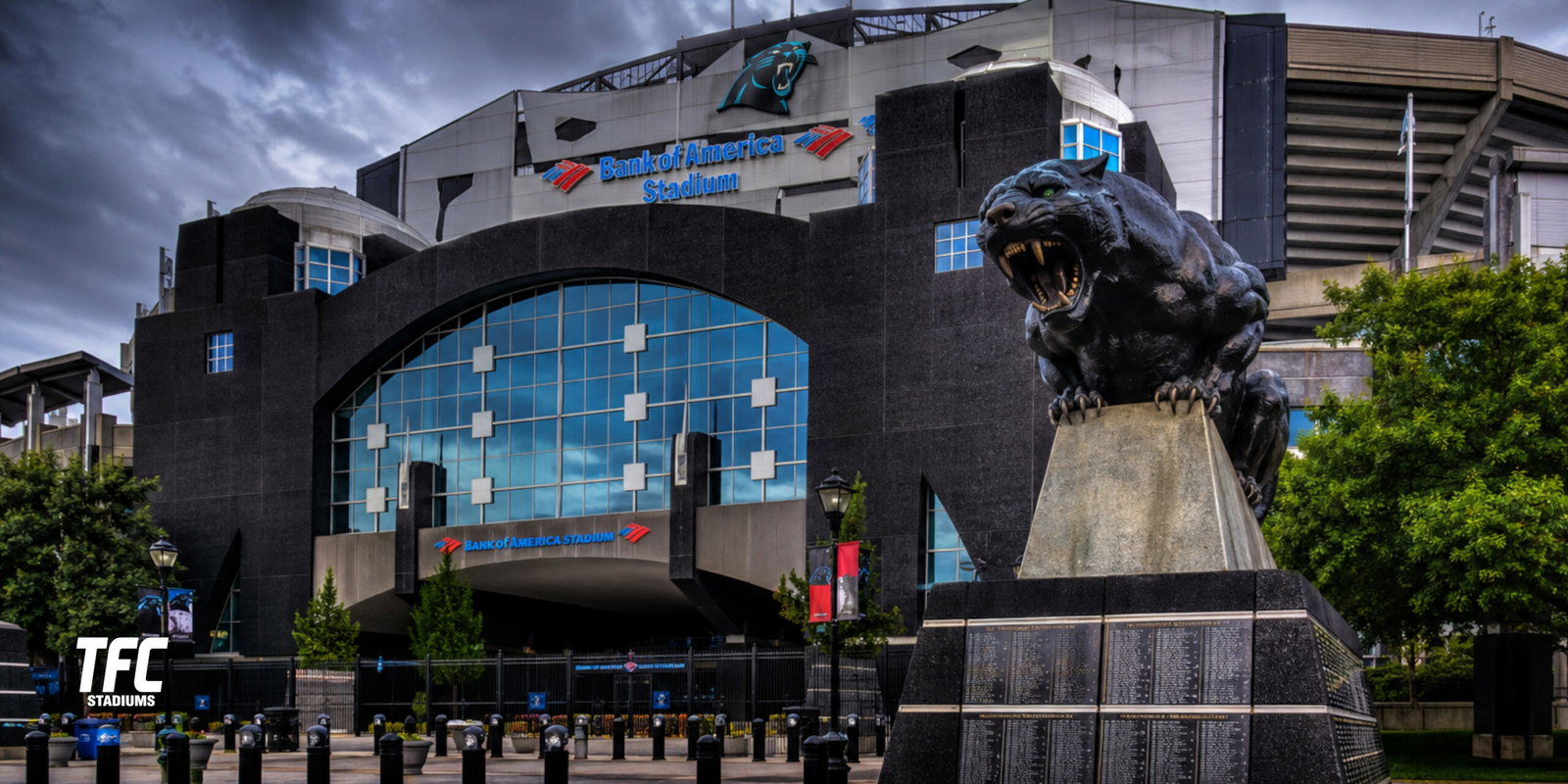
From the outside, the stadium leans heavily into permanence. The design uses exposed steel, dark glass, concrete framing and symmetrical vertical lines that give the structure a fortress-like appearance. It was designed by HOK Sport, now known as Populous, one of the defining stadium architecture firms in modern sports.
The stadium sits directly within Uptown Charlotte rather than being isolated in a sprawling suburban parking wasteland. That choice matters more than people realise. Walking toward the venue through city streets gives the stadium weight and identity. It feels connected to Charlotte rather than dropped onto the map like an afterthought.
At roughly 75,000 seats after renovations and standing room adjustments, the venue balances scale with intimacy surprisingly well. It is large enough to host NFL crowds, international football matches and concerts, but compact enough to keep noise trapped inside the bowl.
That bowl shape is one of the stadium’s biggest architectural strengths.
The Bowl Design Still Works
Some stadiums overcomplicate sightlines with stacked gimmicks and aggressive luxury segmentation. Bank of America Stadium keeps things relatively straightforward. The seating bowl rises steeply, wraps tightly around the field and creates excellent visibility from most sections.
It sounds simple because it is simple.
Good stadium architecture often comes down to restraint. Fans want clear views, strong acoustics and proximity to the action. This building understood the assignment long before every franchise started throwing LED ribbons at the problem.
The steep upper deck helps amplify crowd noise, especially during Panthers playoff games. When the venue is loud, the sound circulates rather than disappearing upward into open air. The result can feel surprisingly hostile for visiting teams, particularly during prime-time matchups.
There is also a subtle psychological effect to the stadium’s enclosed visual profile. The darker exterior materials and narrow vertical openings create a more intimidating atmosphere than the bright, airy look used by many newer venues.
In plain English, it looks like football should hurt there.
The Signature Archways and Towers
The stadium’s monumental entrance towers remain one of its defining architectural features. Large arched openings, flanked by towering black and silver structures, give the building a civic feel that many modern NFL stadiums lack.
It does not look temporary. It does not look trendy.
It looks like somebody expected it to still matter 50 years later.
The Panther statues outside the entrances help reinforce that identity. They are enormous, dramatic and just slightly ridiculous, which is exactly what sports architecture should be sometimes. Nobody travels to a stadium hoping for subtlety.
The statues have quietly become one of the most photographed landmarks in Charlotte. Children climb them. Tourists pose beside them. Rival fans pretend not to enjoy them while absolutely enjoying them.
That is successful stadium branding.
Renovations Without Losing Identity
One of the more impressive aspects of Bank of America Stadium is how it has modernised without erasing its original personality.
Many stadium renovations end up feeling awkward, like putting a giant touchscreen inside a medieval castle. Charlotte’s upgrades have mostly respected the original structure while improving fan experience.
Recent renovations added:
- Larger video boards
- Improved concourses
- Upgraded seating areas
- Expanded social spaces
- Enhanced lighting systems
- Modern hospitality zones
The video boards were a necessary change. The old screens began to feel ancient by NFL standards, which is saying something because NFL owners treat giant scoreboards the way medieval kings treated cathedrals. Bigger always seems spiritually necessary.
Still, the stadium avoided becoming visually cluttered. The core architectural identity remains intact.
That balance matters.
Open-Air Football Still Feels Right
There is a growing arms race in professional sports toward enclosed mega-venues packed with climate control and futuristic roofing systems. Some are incredible engineering achievements. Others feel suspiciously close to airport terminals.
Bank of America Stadium remains proudly open-air.
For football, that works.
The Carolina heat, late-season rain and swirling winds become part of the experience. Weather affects games. Crowd noise escapes into the sky. Sunlight changes the field throughout the afternoon. It feels alive in ways enclosed venues sometimes struggle to replicate.
Rick Dalton would probably describe it as “football with grass stains instead of mood lighting.”
Honestly, he would not be wrong.
Architecture and Charlotte’s Identity
The stadium also mirrors Charlotte itself.
Charlotte is a modern banking city that still wants to project toughness and ambition. Bank of America Stadium reflects that personality through its architecture. It is corporate, yes, but also muscular and grounded.
The venue helped establish Uptown Charlotte as a genuine sports district. Restaurants, bars and entertainment spaces grew around it, transforming game days into city-wide events rather than isolated stadium experiences.
That urban integration is one reason the stadium continues to age well architecturally. It feels woven into the city rather than detached from it.
Compare that with some suburban NFL venues surrounded by oceans of asphalt and chain restaurants, where the atmosphere resembles a logistics depot with tailgating.
Charlotte avoided that trap.
Can It Compete With New NFL Stadiums?
Purely in terms of technological spectacle, newer venues like SoFi Stadium or Allegiant Stadium obviously push further.
But architecture is not only about novelty.
Bank of America Stadium succeeds because it understands purpose. It delivers strong sightlines, urban integration, intimidating scale and recognisable visual identity. Those fundamentals age better than trendy design flourishes.
There is also an authenticity to older NFL venues that many fans still crave. Not every stadium needs a nightclub suspended above the end zone. Sometimes people simply want to watch football while holding a drink that costs approximately the same as a used Honda Civic.
Takeaway
Bank of America Stadium may not be the flashiest venue in the NFL anymore, but it remains one of the league’s most coherent architectural successes.
It looks like football. It sounds like football. It feels tied to its city.
That combination is harder to design than many modern projects would like to admit.
The stadium’s greatest achievement might be that it still feels relevant without constantly begging for attention. No retractable roof gymnastics. No overwhelming visual chaos. Just a confident structure that understands exactly what it is.
And after nearly three decades, that confidence still works.
About the Author