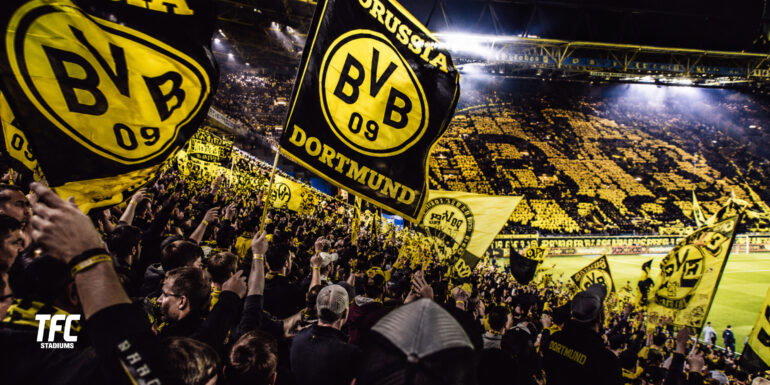
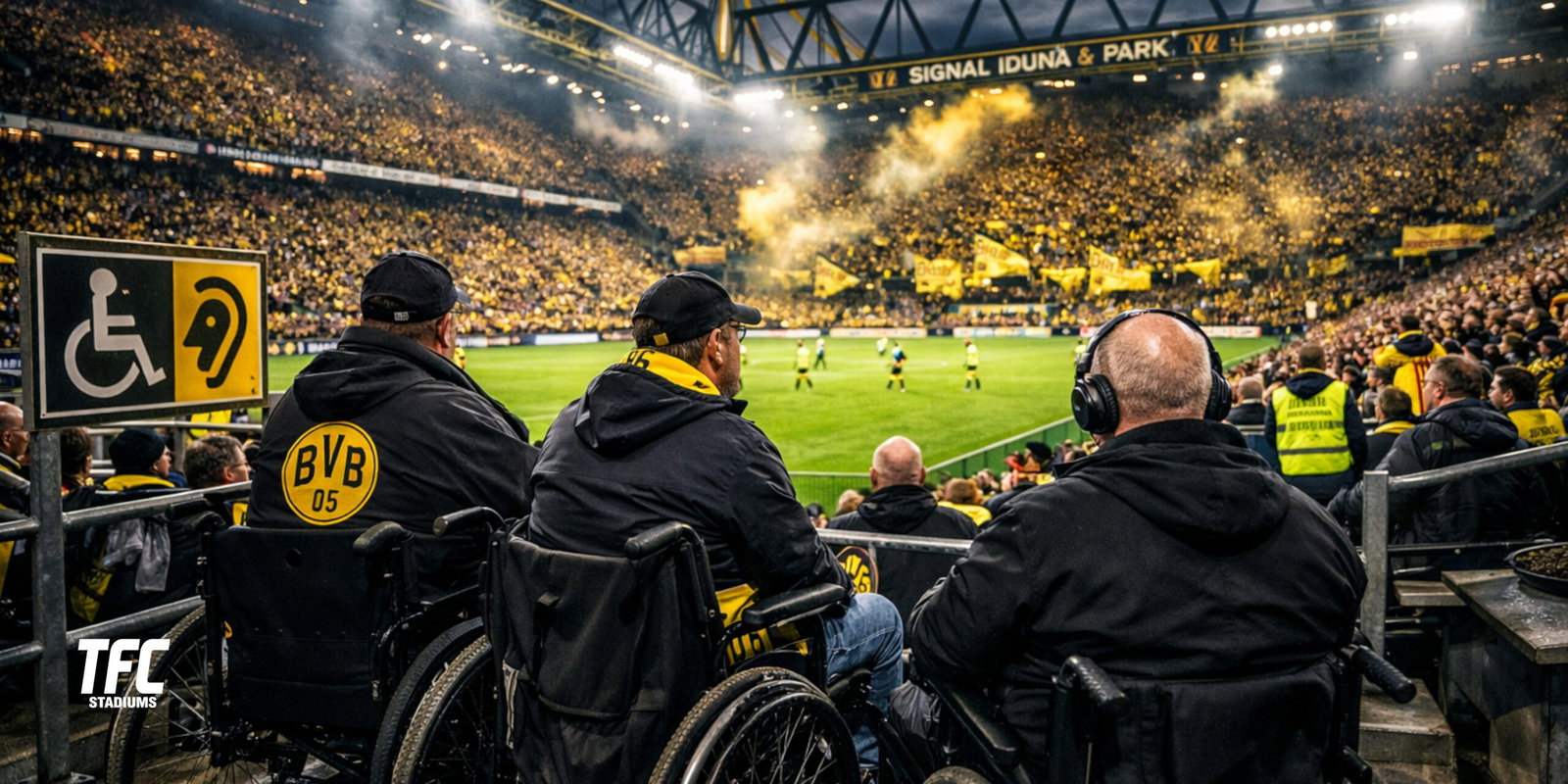
For all its noise, colour and organised chaos, Signal Iduna Park does a better job with accessibility than many major football stadiums. That matters, because 81,000 people trying to get into one place at the same time can feel like a military campaign with more scarves and less cavalry.
Borussia Dortmund has made a serious effort to ensure supporters with disabilities can enjoy the matchday experience rather than spend the afternoon wrestling with awkward entrances, steep stairs and bewildered stewards pointing in three different directions.
Wheelchair Access and Seating
Signal Iduna Park has 72 wheelchair spaces, located in Blocks 3 and 6 on the East and West stands. These areas are at ground level and give a clear view of the pitch without needing to navigate endless ramps or staircases.
Wheelchair users must book a designated wheelchair ticket. Borussia Dortmund does not allow wheelchair users to attend with a regular seat or standing ticket because the evacuation routes and safety procedures are built around the specific wheelchair areas. It sounds strict, because it is, but in a packed stadium that can empty in seconds, it is also understandable.
Wheelchair tickets for Borussia Dortmund home matches are typically priced at around €15. A companion or carer ticket can often be included, depending on the disability documentation provided.
Accessible Entrances
Supporters with severe disabilities using Block 9 enter through a dedicated North-West entrance beside the Fanwelt shop. This avoids the usual crush around the main gates, which on a Champions League night can resemble a human traffic jam in yellow and black.
Wheelchair sections in Blocks 3 and 6 are also designed for direct access from ground level, with volunteers and stewards available to help supporters find their place.
Support for Visually Impaired Fans
Signal Iduna Park has 20 seats for visually impaired supporters in Block 5 of the East Stand, along with 20 seats for companions. Headsets are provided with live audio commentary designed specifically for blind and visually impaired fans. Volunteers distribute and collect the equipment before and after the match.
The commentary is also available through an FM frequency throughout the stadium, which is a thoughtful touch. It means supporters are not tied to a single location if they prefer to sit elsewhere.
A visually impaired ticket, including entry for a companion, costs around €15. To qualify, supporters usually need documentation showing a recognised visual impairment.
Support for Hearing-Impaired Fans
The stadium provides 25 dedicated seats for hearing-impaired supporters in Block 34 of the West Stand. A sign language interpreter translates important announcements and information during the match. There is even a kiosk service designed with hearing-impaired supporters in mind, which is one of those small details that says a great deal about how seriously the club takes accessibility.
Accessible Toilets and Facilities
Accessible toilets are located close to the wheelchair and visually impaired sections, particularly in the East Stand. Medical rooms and volunteer assistance are also nearby, so fans do not have to trek halfway around the stadium if they need help.
Catering support is available in some accessible sections. Volunteers can bring food and drink directly to supporters in wheelchair areas, which is especially useful given that navigating the concourse during half-time is not exactly a peaceful stroll. It is more like trying to thread your way through a yellow-and-black stampede.
Accessible Parking and Getting to the Stadium
Signal Iduna Park has dedicated accessible parking around 300 to 350 metres from the stadium. Spaces are signposted, level and generally close enough to avoid an exhausting journey before the match has even started. Parking permits are usually required and should be arranged in advance through the club.
For some fixtures, accessible parking is located in Car Park C2. There are also around 150 parking spaces for disabled supporters across the wider stadium area.
Public transport is also fairly accessible. The nearby tram and rail stations have step-free routes, and the stadium itself is set up with ramps and level access around the main concourses.
Stadium Tours and Non-Matchday Access
Borussia Dortmund offers barrier-free stadium tours that are wheelchair accessible. These tours include many of the major areas of Signal Iduna Park and are designed specifically for visitors who may struggle with the standard self-guided route.
Interestingly, the regular self-guided stadium walk is not fully accessible and is not suitable for wheelchair users. If accessibility matters, the barrier-free guided tour is very much the better option.
How Signal Iduna Park Compares
Many large European stadiums claim to be accessible because they have a lift and one disabled toilet hidden somewhere near Gate 47. Signal Iduna Park goes further. It offers dedicated seating, specialist audio commentary, sign language interpretation, accessible parking, companion tickets and staff support all in one of the loudest, busiest football grounds in Europe.
Compared with many older British grounds, where accessibility can still feel like an afterthought squeezed between a stairwell and a pie stand, Dortmund is ahead of the game. Not perfect, certainly. Ticket demand is high and accessible spaces are limited. But the club has clearly put thought into making sure the famous Yellow Wall can be experienced by more than just the fans who can climb six flights of stairs without complaint.
About the Author