Some stadiums host great matches. Others quietly change the way stadiums are built.
The Allianz Arena in Munich belongs firmly in the second category. When it opened in 2005, it did not simply give FC Bayern Munich a new home. It rewrote expectations about what a football stadium could look like, how it could interact with a city, and how architecture could shape atmosphere.
Designed by Jacques Herzog and Pierre de Meuron, the same architects behind Beijing National Stadium, the Allianz Arena fused bold design with practical engineering. Its influence can now be seen across Europe, North America, and even Asia.
In short, the building became a blueprint.
The Birth of a New Kind of Stadium
By the early 2000s, stadium architecture was at a crossroads. Many venues built during the late twentieth century were functional but uninspiring. Concrete bowls dominated skylines. Atmosphere came from supporters rather than the structure itself.
The Allianz Arena arrived with a very different philosophy.
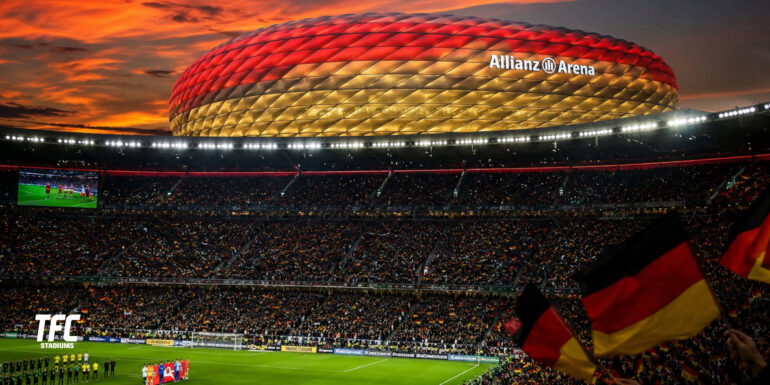
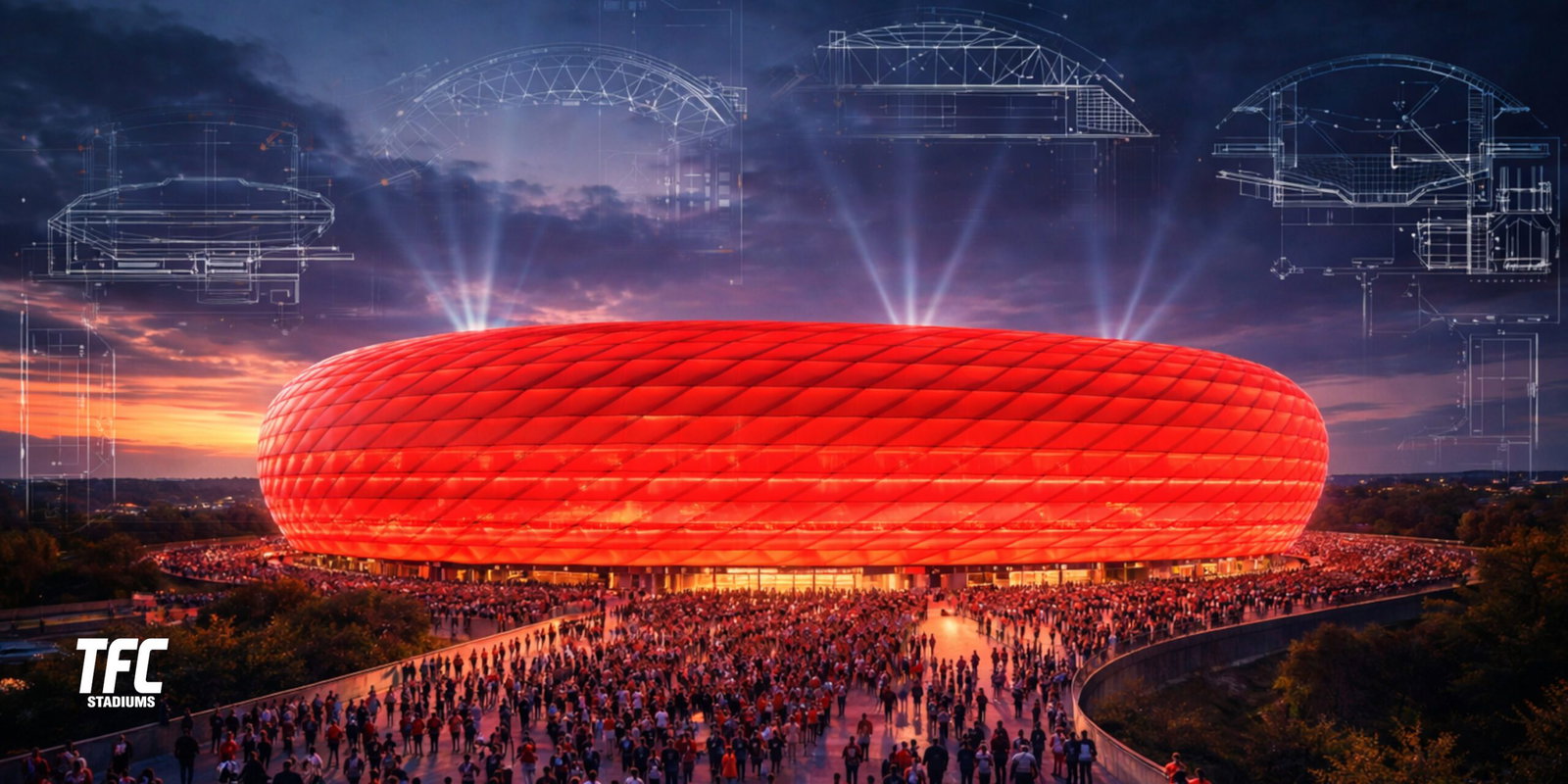
The stadium introduced a fully illuminated exterior made from inflated ETFE plastic panels. Each panel could glow in different colours, allowing the stadium to visually transform depending on who was playing. When FC Bayern Munich hosted a match, the stadium glowed red. When TSV 1860 Munich played there during their tenancy, it turned blue.
That may sound like a cosmetic feature, yet it changed how architects thought about stadium identity. A venue was no longer just a structure. It became a living billboard for the club inside.
Within a few years, illuminated façades became one of the defining features of modern arenas.
The ETFE Revolution
Before Munich, ETFE was rarely used at this scale in sports architecture.
The Allianz Arena used nearly three thousand inflated ETFE panels to form its outer shell. These panels were lightweight, durable, and capable of holding internal lighting systems. Compared with glass or concrete, they allowed designers to create curved surfaces without enormous structural weight.
The benefits were practical as well as aesthetic.
• lighter construction reduced structural loads
• translucent surfaces allowed dramatic lighting
• panels could be individually replaced if damaged
• insulation properties helped regulate internal temperature
Today, ETFE appears in stadiums around the world. The material can be seen at Tottenham Hotspur Stadium, U.S. Bank Stadium, and the roof of Mercedes-Benz Stadium.
Munich proved the material was not just viable. It was spectacular.
Architecture as Branding
One of the subtler impacts of the Allianz Arena is how it tied stadium design directly to club identity.
Older stadiums relied on banners, paint, or flags. The architecture itself rarely communicated anything about the team.
Munich flipped that idea.
The colour changing façade turned the stadium into a gigantic emblem visible from kilometres away. When Bayern played at home, the red glow became part of the match day ritual.
Clubs and owners around the world noticed.
Modern stadium projects now consider branding as part of the architecture itself. Lighting systems, external media screens, and programmable façades allow venues to shift colours for events, concerts, or national matches.
The stadium does not just host the spectacle. It participates in it.
A Fan Experience Designed from the Ground Up
Another lasting influence lies inside the stadium.
The Allianz Arena was built with steep seating tiers that keep supporters close to the pitch. Sightlines were carefully engineered so that even the highest seats maintain a clear view of play.
That focus on fan proximity has shaped later venues across Europe.
Key design principles that emerged from Munich include:
• steeper stands to intensify atmosphere
• open concourses that improve crowd flow
• clear visual connections between food areas and the pitch
• large circulation zones to reduce congestion
These details sound mundane until you experience the difference on match day. The stadium feels less like a concrete maze and more like a carefully choreographed space for sixty thousand people.
Many modern stadiums now adopt similar layouts.
The Influence on Modern Stadium Design
Look across the newest generation of stadiums and the Allianz Arena’s fingerprints appear everywhere.
Lighting has become architectural rather than decorative. Stadium skins are treated like canvases for colour and motion. Even the idea that a stadium should stand out in a skyline traces back to Munich’s bold approach.
Several influential venues echo these ideas:
• Tottenham Hotspur Stadium combines sharp geometry with dynamic lighting that changes during events
• SoFi Stadium uses massive digital surfaces and lighting to transform the building’s appearance
• Mercedes-Benz Stadium merges striking architecture with a dramatic LED exterior and retractable roof
None replicate Munich exactly. Instead, they build on its core idea that stadiums should feel like landmarks, not anonymous arenas.
The Cultural Impact
The Allianz Arena quickly became one of the most recognisable stadiums in the world. Its glowing exterior appears regularly in television broadcasts, video games, and tourism campaigns.
For FC Bayern Munich, it reinforced the club’s modern identity. Bayern had long been a powerhouse on the pitch. Now the stadium visually matched that ambition.
It also helped shift public expectations.
Fans now expect stadiums to look distinctive, offer comfortable circulation spaces, and deliver dramatic night time visuals. A simple concrete bowl would feel strangely old fashioned.
In that sense, Munich changed not just architecture but taste.
A Quiet Architectural Legacy
The Allianz Arena did not introduce every concept used in modern stadiums. Yet it assembled them into something strikingly coherent.
It proved that stadiums could be technologically ambitious without losing their connection to supporters. It showed how architecture could reinforce club identity. It demonstrated that materials such as ETFE could reshape what a stadium looks like at night.
Most importantly, it reminded architects that stadiums are emotional spaces.
When the lights glow red across Munich and sixty thousand supporters fill the stands, the building does more than hold a match. It amplifies the theatre of football itself.
About the Author