MetLife Stadium was designed to host enormous crowds, blockbuster sporting events, and concerts capable of rattling New Jersey into the next ZIP code. It comfortably accommodates more than 82,000 fans, making it one of the largest stadiums in the NFL. The challenge has never been attracting people. It has been helping them navigate, engage, and enjoy an experience that stretches well beyond four quarters of football.
That is where augmented reality, or AR, enters the conversation.
Unlike virtual reality, which places users in a completely digital world, augmented reality layers digital information onto the real environment through smartphones or smart glasses. At stadiums, that means interactive maps, player statistics, instant replays, games, promotions, and navigation appearing on your screen while you’re standing in the middle of the concourse.
MetLife Stadium has steadily expanded its digital infrastructure, and while it has not rolled out the same high profile AR activations seen at some newer venues, its investment in connectivity, mobile technology, and fan engagement has laid solid foundations for richer augmented experiences.
As someone who grew up when the biggest piece of stadium technology was a guy carrying hot dogs on his head, watching fans point their phones at a football field to unlock digital content still feels faintly ridiculous. Then again, so did streaming movies over the internet.
The Technology That Makes AR Possible
Augmented reality depends on one thing above everything else.
Reliable connectivity.
Without fast wireless networks, AR experiences become sluggish and frustrating. Nobody wants to wait twenty seconds for an animation while the quarterback is already lining up for the next snap.
MetLife Stadium has invested heavily in its wireless infrastructure.
Key technology includes:
| Technology | Purpose |
|---|---|
| Stadium-wide Wi-Fi | Supports tens of thousands of connected devices simultaneously |
| Distributed Antenna System (DAS) | Improves mobile phone coverage throughout the venue |
| High-density network access points | Maintains bandwidth during sold out events |
| Mobile ticketing integration | Connects digital services into one platform |
During major NFL games, fans collectively generate several terabytes of mobile data. Events such as international football matches and major concerts regularly push wireless traffic to record levels.
That capacity creates opportunities for more advanced AR experiences every season.
Finding Your Seat Without Looking Lost
Every stadium visitor has seen it.
Someone holding their ticket upside down while wandering into entirely the wrong section.
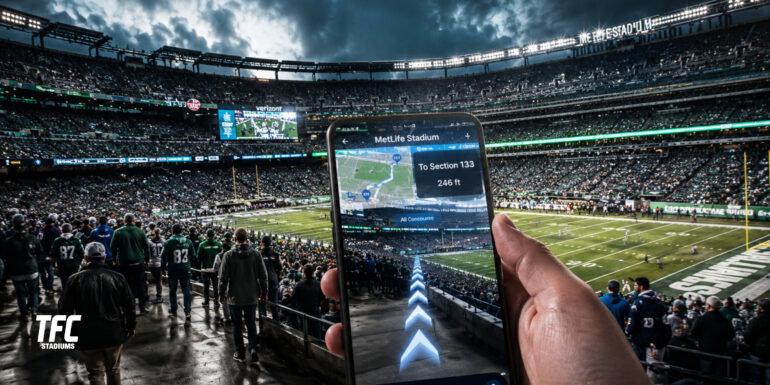
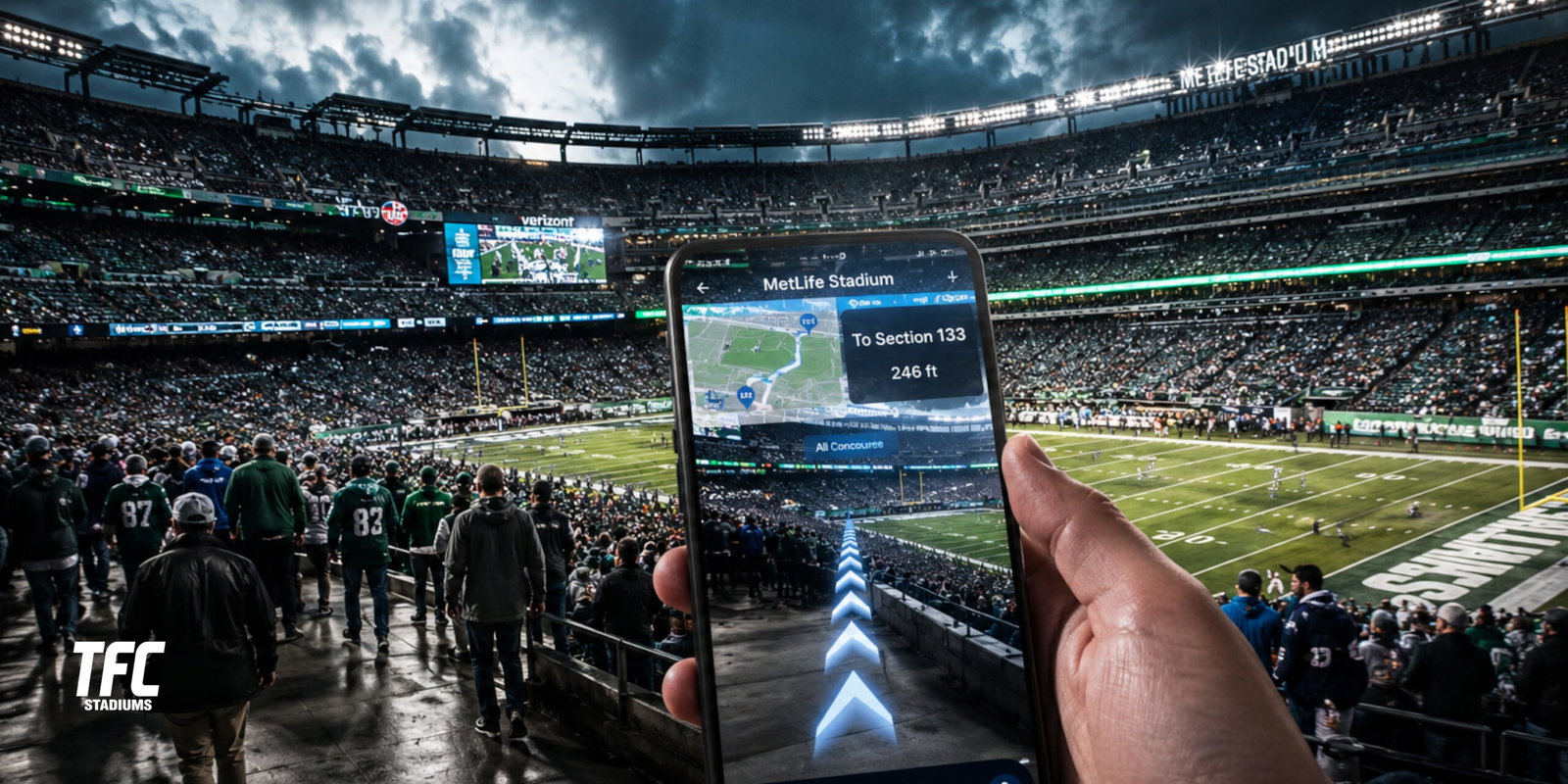
Interactive AR navigation aims to solve that problem.
Instead of reading confusing directional signs, fans can simply open the stadium app and follow digital arrows overlaid onto the real concourse through their phone camera.
Potential uses include:
- Seat directions
- Accessible routes
- Restroom locations
- Merchandise stores
- Food vendors
- Parking guidance after the game
For first time visitors, especially during NFL games where crowds arrive simultaneously, reducing confusion also reduces congestion.
That benefits everyone.
Bringing Statistics Into Your Hands
Watching football has become a data experience.
Fans expect more than simply watching the action.
Imagine pointing your phone toward the field and seeing:
- Quarterback completion percentage
- Receiver separation
- Defensive formations
- Drive summaries
- Player speed
- Win probability
Most of this information already exists.
The challenge is presenting it naturally without overwhelming the fan.
Broadcasters have spent decades refining how statistics appear on television. Stadium AR is beginning to borrow many of those lessons.
Instead of constantly checking fantasy football apps between plays, supporters can potentially access relevant information while keeping their eyes on the action.
Interactive Games During Breaks
Timeouts, television breaks and halftime create valuable opportunities for fan engagement.
AR experiences can include:
- Virtual quarterback challenges
- Digital treasure hunts
- Mascot interactions
- Sponsor competitions
- Stadium trivia
- Collectable digital badges
These activities keep fans entertained without pulling attention away from the live event.
Sponsors also appreciate experiences that fans voluntarily interact with rather than simply walking past another advertising board.
Everyone wins.
Well, except perhaps the person who still insists the wave counts as entertainment.
Food, Drinks and Merchandise
Large stadiums often present one surprisingly difficult challenge.
Finding decent food before kickoff.
AR can simplify that process.
Fans could scan the concourse and instantly see:
- Shortest concession queues
- Nearby menu options
- Dietary filters
- Special promotions
- Merchandise availability
Rather than wandering aimlessly looking for barbecue or pizza, visitors receive real time information based on location.
The technology also helps stadium operators distribute crowds more evenly across concession areas, increasing sales while reducing waiting times.
That is the rare business solution that actually makes customers happier.
Social Media and Shareable Moments
Modern sporting events generate millions of social media posts.
AR makes those posts more entertaining.
Fans increasingly expect:
- Team-themed filters
- Virtual trophies
- Player animations
- Interactive backgrounds
- Celebration graphics
Imagine recording a touchdown celebration with digital fireworks erupting around the stadium or giant team logos appearing above the field.
These experiences encourage supporters to create content that effectively markets the stadium for free.
It is advertising powered by enthusiasm rather than billboards.
Preparing for the FIFA World Cup 2026
One reason augmented reality has become a growing priority is the arrival of global football’s biggest tournament.
MetLife Stadium is scheduled to host matches during the 2026 FIFA World Cup, including the final. That means welcoming hundreds of thousands of international visitors, many of whom will be attending the venue for the first time.
AR could play a valuable role by providing:
- Multilingual navigation
- Interactive stadium guides
- Local transport information
- Tourist recommendations
- Real time event updates
Visitors unfamiliar with the venue could access directions and information without relying entirely on static signs or staff assistance.
Large international tournaments often accelerate technology adoption, making the World Cup a natural opportunity for new digital experiences.
Comparing MetLife With Other NFL Stadiums
Several NFL venues have become testing grounds for immersive technology.
| Stadium | Digital Innovation |
|---|---|
| SoFi Stadium | Extensive mobile integration and immersive fan content |
| Mercedes-Benz Stadium | Advanced app functionality with interactive experiences |
| Allegiant Stadium | Digital wayfinding and connected fan services |
| MetLife Stadium | Strong infrastructure with room for expanded AR experiences |
MetLife’s advantage lies in its scale.
Any successful AR system deployed here immediately proves it can function under some of the busiest conditions in American sport.
If it works with more than 82,000 spectators all trying to upload touchdown videos simultaneously, it can probably work almost anywhere.
The Challenges Still Facing Stadium AR
Despite impressive advances, augmented reality remains a developing technology.
Several obstacles remain.
Battery life becomes an issue during long events.
Some fans simply prefer watching the game without holding a phone for three hours.
Others worry that excessive digital overlays could distract from the live experience.
There is also the cost.
Building accurate stadium mapping, maintaining apps, upgrading networks, and producing fresh AR content requires continual investment.
The technology only succeeds if fans genuinely find it useful rather than treating it as a novelty they try once before forgetting about.
Looking Ahead
The next decade will likely see augmented reality become less obvious but far more useful.
Instead of flashy gimmicks, expect practical features that quietly improve the day.
Artificial intelligence could personalise statistics based on favourite players. Navigation may automatically reroute around busy concourses. Live translations could help overseas visitors. Future smart glasses might eventually replace smartphones altogether, placing information directly into a fan’s field of vision.
MetLife Stadium already possesses many of the digital foundations required for that future.
The stadium has invested in connectivity, mobile infrastructure, and scalable technology that can support richer experiences as software continues to evolve.
Fans still come for the football, the concerts, and those unforgettable moments that make eighty thousand strangers sound like one enormous family reunion.
If augmented reality helps them find their seat faster, avoid the longest beer queue, and settle the argument about whether that receiver really got both feet in bounds, then perhaps the future has arrived at exactly the right pace.
Takeaway
Augmented reality is unlikely to replace the magic of live sport, nor should it. The roar after a game winning touchdown, the anticipation before kickoff, and the shared emotion of a packed stadium cannot be downloaded.
What AR can do is remove many of the small frustrations that come with attending major events while adding useful layers of information and entertainment. For a venue as large and busy as MetLife Stadium, that balance matters.
The future of the stadium experience is not about replacing reality. It is about making reality easier to navigate, richer to understand, and just a little more fun, preferably without needing to ask the usher where Section 312 is for the third time.
About the Author