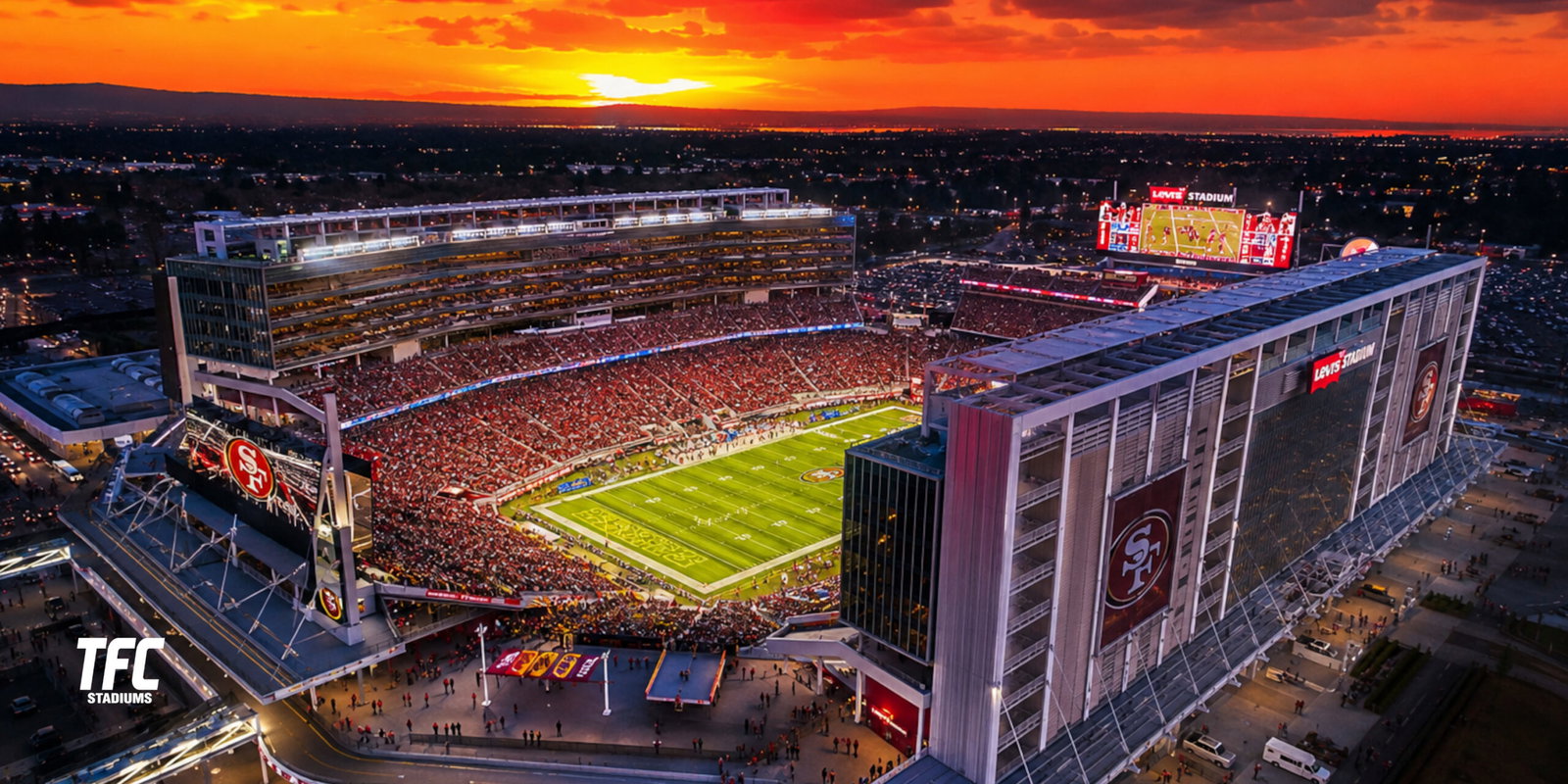
There are NFL stadiums that feel massive, loud, and expensive. Then there is Levi’s Stadium, a building that often feels like Silicon Valley accidentally decided to host football games.
Home of the San Francisco 49ers, Levi’s Stadium arrived in 2014 with the kind of confidence usually reserved for tech startups promising to “change everything”. Some stadiums lean into nostalgia. Levi’s leaned into fibre optics, sustainability, app integration, and enough engineering tricks to make a civil engineer quietly emotional over lunch.
It also had to survive earthquakes, California heat, enormous crowd loads, and the expectation that fans should somehow stream six replays while ordering garlic fries without missing third down.
No pressure, then.
A Stadium Built for Silicon Valley
Levi’s Stadium was designed with a very particular identity in mind. This was not meant to be a concrete bowl dropped into a car park. The project aimed to reflect the surrounding tech culture of Santa Clara and the Bay Area.
Architecturally, the stadium uses open terraces, glass-heavy facades, and wide concourses that feel more like a modern airport terminal than a traditional NFL venue. The engineering challenge was balancing openness with structural strength.
That sounds simple until you remember California occasionally decides to shake violently without warning.
The stadium’s steel framework and reinforced concrete systems were specifically designed to meet demanding seismic standards. Engineers used flexible structural elements that allow the building to absorb and distribute earthquake forces rather than resist them rigidly. In plain English, the building is designed to move without falling apart, which is generally considered a positive feature.
The Green Roof That Changed the Look of NFL Stadiums
One of the most visually distinctive engineering features at Levi’s Stadium is its green roof.
Rather than covering the structure with standard industrial roofing, designers installed a rooftop garden system containing thousands of square feet of vegetation. The roof helps regulate temperature, absorb rainwater, and reduce heat reflection.
It also makes the stadium look significantly less like a giant warehouse.
The living roof system required careful weight distribution calculations because saturated soil and irrigation systems add substantial load pressure. Engineers had to reinforce support structures while ensuring proper drainage beneath the vegetation layers.
There is something deeply Californian about building a football stadium that can also technically qualify as landscaping.
Solar Power and Energy Systems
Levi’s Stadium became one of the NFL’s flagship sustainability projects, and that was not marketing fluff. The engineering team integrated solar panels throughout the venue to generate renewable electricity on-site.
The stadium’s energy systems were designed to reduce operational strain during major events, particularly when tens of thousands of people simultaneously decide they need phone charging, instant replays, and overpriced nachos.
Energy-efficient LED lighting systems were installed throughout the building, reducing power demands while improving visibility for broadcasts and spectators. The lighting infrastructure also allows rapid colour and atmosphere changes during concerts and major sporting events.
Modern stadium engineering is increasingly part theatre production, part data centre.
Wi-Fi, Connectivity, and the Battle Against 70,000 Phones
One of the least glamorous but most difficult engineering feats inside any modern stadium is connectivity.
Fans expect seamless internet access while surrounded by tens of thousands of other people attempting exactly the same thing. That is not easy. In fact, it is borderline absurd.
Levi’s Stadium was built with high-density Wi-Fi infrastructure from the start, including hundreds of distributed antenna systems positioned throughout seating areas and concourses. Engineers had to calculate signal overlap, interference zones, and traffic spikes during major moments.
Touchdowns create digital chaos.
The venue also incorporated extensive fibre optic cabling beneath the stadium, allowing massive data throughput for streaming, media operations, security systems, and mobile services.
Older stadiums often bolt technology on later. Levi’s treated technology as part of the foundation itself.
Designing for Heat, Sun, and Fan Comfort
One of the more controversial aspects of Levi’s Stadium during its early years involved sunlight and temperature distribution.
The west side of the stadium can become brutally hot during afternoon games, while the opposite side remains comparatively comfortable. It became one of the most talked-about design quirks in the NFL.
From an engineering perspective, the issue stemmed partly from orientation and environmental trade-offs. Designers prioritised open-air aesthetics and skyline views, but Santa Clara’s climate turned sections of the seating bowl into what occasionally resembled a large convection oven.
To address this, engineers and operators later introduced additional shading solutions, cooling initiatives, and hydration infrastructure.
It is one of those rare examples where architectural ambition collided directly with the sun, and the sun won on points.
Earthquake Engineering Beneath the Surface
California stadium projects live under constant seismic scrutiny, and Levi’s Stadium is no exception.
The structure uses advanced lateral force resisting systems, reinforced bracing, and carefully distributed load paths designed to maintain integrity during seismic activity. Expansion joints and flexible materials help absorb movement rather than transferring stress directly through the building.
The engineering philosophy behind modern earthquake-resistant design is not about preventing movement altogether. That is impossible. Instead, it is about controlled flexibility.
Think of it like a heavyweight boxer rolling with a punch rather than standing perfectly still and getting flattened.
Not a poetic comparison, perhaps, but probably accurate.
The Massive Video Board and Structural Challenges
Levi’s Stadium features one of the largest video boards in professional football, and supporting something that size is not as straightforward as hanging a television on a wall.
The board required immense steel support systems capable of resisting wind loads, vibration, and long-term structural fatigue. Engineers also had to account for weight distribution without compromising sightlines or overall stadium balance.
Modern video boards function almost like suspended buildings in their own right. They generate heat, consume enormous power, and place significant demands on support infrastructure.
Fans mostly notice fantasy football updates and replay angles. Structural engineers probably stare at the support brackets with quiet admiration.
Sustainability Beyond Public Relations
Many stadiums advertise sustainability. Levi’s Stadium genuinely integrated it into the project’s core systems.
The venue achieved LEED Gold certification through a combination of water conservation systems, recycled construction materials, energy-efficient operations, and environmentally conscious landscaping.
Water recycling systems reduce waste across the stadium, while efficient plumbing infrastructure lowers consumption during major events. That matters more than people realise when tens of thousands of fans all decide halftime is the ideal moment to visit the toilets simultaneously.
Even the transportation planning surrounding the stadium reflected environmental priorities, with connections to public transit systems intended to reduce vehicle congestion and emissions.
How Levi’s Stadium Influenced Modern Stadium Design
Levi’s Stadium arrived during a major shift in sports venue philosophy.
Older NFL venues focused almost entirely on capacity and intimidation. Newer stadiums increasingly operate as year-round entertainment complexes loaded with technology, sustainability features, and premium hospitality infrastructure.
Levi’s helped push that transition forward.
Its emphasis on integrated technology, renewable energy, app-driven fan experiences, and flexible event hosting influenced later projects across American sports. You can see elements of its design philosophy echoed in newer venues that treat connectivity and sustainability as basic expectations rather than luxury extras.
Some traditionalists still prefer old concrete cathedrals where the beer lines are terrifying and mobile signal disappears entirely by kickoff. Fair enough. There is charm in chaos.
But from an engineering perspective, Levi’s Stadium represented the NFL stepping fully into the modern era.
TFC Takeaway
Levi’s Stadium is not perfect. The heat issues became infamous, ticket prices remain painful, and no amount of engineering can stop a fan from spilling nacho cheese down their jersey in the third quarter.
Still, the stadium remains one of the most ambitious engineering projects in modern American sport.
It blends seismic resilience, sustainability, digital infrastructure, and large-scale entertainment design into a venue that feels unmistakably tied to its region. It could only really exist in Silicon Valley, where even football stadiums are expected to behave like tech products.
Some stadiums are remembered for atmosphere. Some for history.
Levi’s Stadium might ultimately be remembered for proving that engineering itself can become part of the spectacle.
About the Author