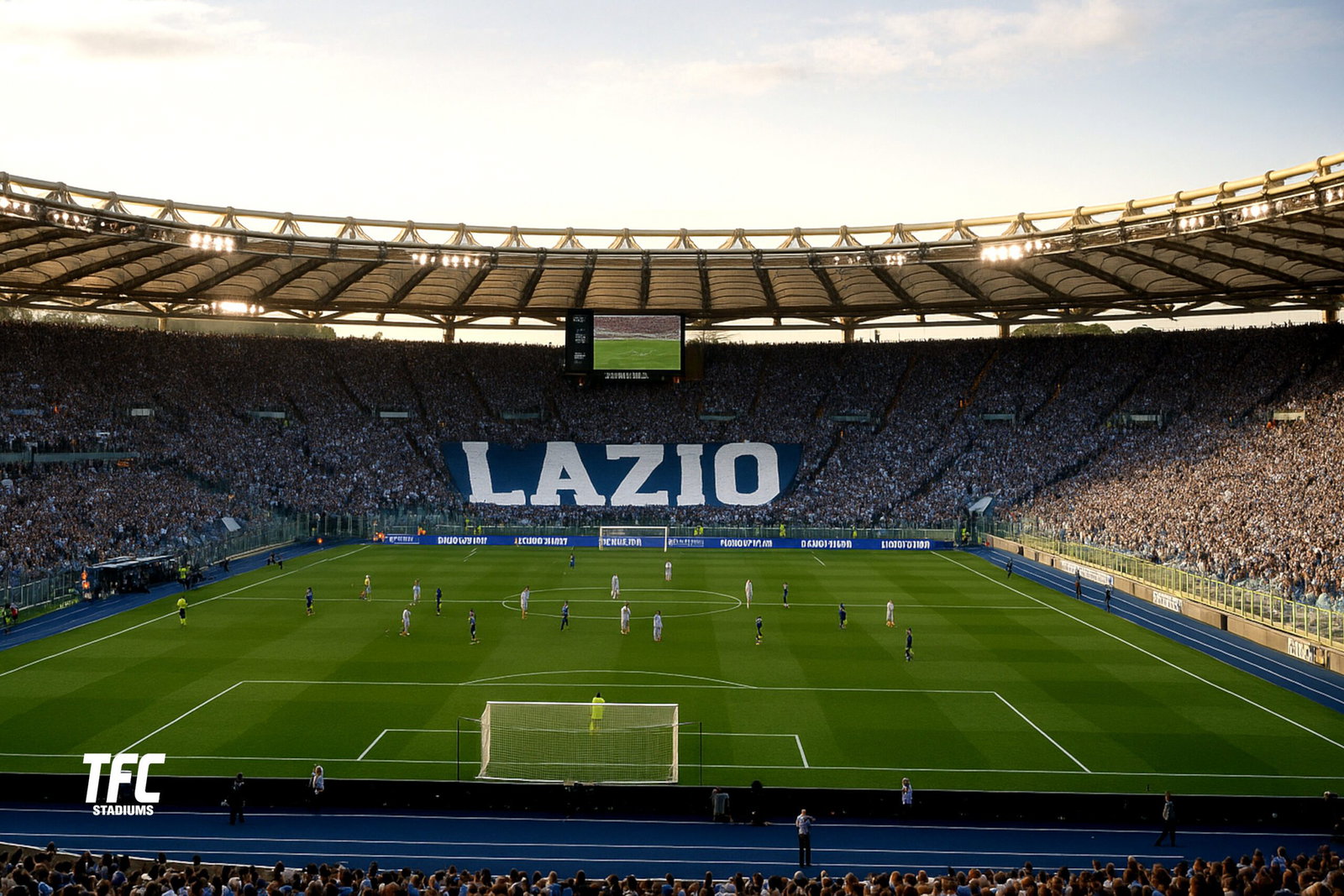
The Olympic Home of the Biancocelesti
Few stadiums in European football hold as much cultural weight as Rome’s Stadio Olimpico. For Lazio, it has been more than a home ground. It has been a stage where triumph, heartbreak, and defiance have played out beneath the Roman sky. Since moving in full-time in the 1950s, Lazio’s history has become inseparable from the concrete colossus on the banks of the Tiber.
The Olimpico is shared with city rivals Roma, and that shared tenancy adds a daily tension to the atmosphere. Even on quiet training days, the stands seem to echo the energy of the eternal Derby.
A Stadium with Imperial Roots
The Stadio Olimpico began life as part of Mussolini’s grand project for a sporting complex, initially known as the Stadio dei Cipressi before it evolved into the Stadio dei Centomila. Lazio played their first match there in 1953, long before floodlights and VIP lounges were installed. It was rebuilt and renamed for the 1960 Olympics, gaining its current name and status as a national landmark.
By the 1980s and 1990s, the Olimpico had become one of Europe’s grand stages. Its track, open bowl, and sheer scale gave Lazio’s matches a sense of grandeur, even when the team’s performances did not always match the setting.
The Glory Years
For Lazio fans, the late 1990s represent the club’s golden era at the Olimpico. Under Sven-Göran Eriksson, the team lifted the 1999 Cup Winners’ Cup and claimed the Serie A title in 2000. The celebrations that followed that second Scudetto remain etched in the collective memory. Flags flooded the Curva Nord, fireworks lit the night sky, and the Olimpico roared as if the empire itself had returned.
That era also produced a string of unforgettable players: Alessandro Nesta, Pavel Nedvěd, Juan Sebastián Verón, and Simone Inzaghi, who would later return to manage the club. Their victories in the Coppa Italia and Supercoppa Italiana cemented the stadium’s status as a fortress for Lazio’s ambitions.
The Derby della Capitale
No discussion of Lazio at the Olimpico is complete without the Derby della Capitale. The fixture is less a football match and more a civil war in miniature. The Curva Nord, Lazio’s stronghold, faces the Curva Sud of Roma, and for ninety minutes the stadium becomes a cauldron of colour, smoke, and raw emotion.
Historic victories, like the 3–1 win in the 2013 Coppa Italia Final over Roma, carry weight far beyond silverware. They shape identity. For Lazio, beating Roma on shared turf feels like reclaiming a piece of the city itself.
Modern Era and Renovation
While the Olimpico’s design shows its age, it remains iconic. Plans to modernise or relocate have circulated for years, but Lazio’s faithful have a stubborn affection for their home. The track separating the stands from the pitch is often criticised, yet it gives the stadium its distinct grandeur. It’s the same track that witnessed Olympic champions and World Cup glory in 1990.
Today, Lazio’s performances under Maurizio Sarri have restored a sense of tactical pride. European nights under the floodlights still draw passionate crowds, and the Curva Nord continues to set the tone for the club’s spirit.
The Symbol of Continuity
In a football world obsessed with modern arenas and corporate polish, the Stadio Olimpico remains defiantly old-school. For Lazio, it symbolises both history and identity. From Scudetto celebrations to derbies filled with fireworks and banners, every moment there carries the weight of legacy.
As the club looks to the future, the Olimpico stands as a monument to persistence. It’s imperfect, vast, occasionally chaotic, but it’s Rome, and it’s home.
About the Author