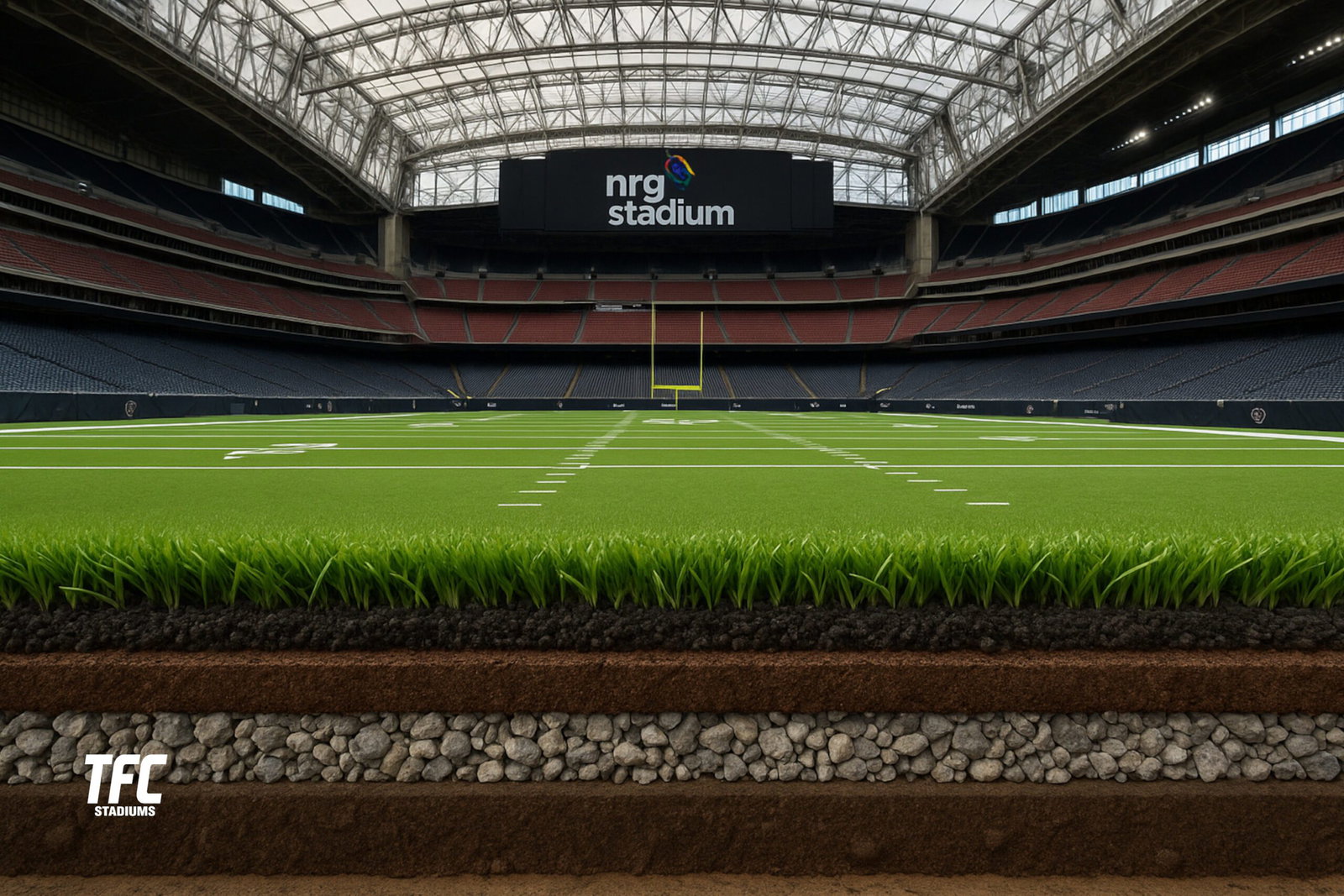
Few stadiums in the NFL have faced more scrutiny over their playing surface than NRG Stadium. From its early days hosting the Houston Texans to international soccer matches and rodeos, the venue has long been a testing ground for field innovation. Over time, its technology has evolved to balance player safety, durability, and the demands of a multi-use calendar.
The Turf Transition
When NRG Stadium opened in 2002, it made headlines as the first NFL venue with a retractable roof. Beneath that roof was a grass field composed of modular trays designed to be removed and replaced as needed. It was a clever idea in theory, but it quickly became a logistical headache.
The trays often shifted, creating uneven seams that players complained about. In 2015, after years of criticism, the Texans transitioned to a consistent artificial surface known as Hellas Matrix Turf. This synthetic option ensured uniformity and player safety, particularly for high-traffic events and short turnaround times.
Precision Engineering Beneath the Surface
Today’s field system at NRG Stadium is an intricate blend of engineering and maintenance. The artificial turf sits atop a specialised drainage and shock absorption system. Beneath it, layers of infill material replicate the bounce and feel of natural grass, while maintaining stability across Houston’s humid conditions.
Field sensors monitor moisture and temperature to ensure optimal conditions. Even the retractable roof plays a part, helping regulate light and heat exposure during the extreme Texas summers.
Versatility and Rapid Changeovers
One of the main reasons NRG adopted advanced field technology was its packed schedule. The venue hosts Texans home games, college football, concerts, soccer friendlies, and the Houston Livestock Show and Rodeo.
The turf system allows crews to remove or cover the field quickly, often within hours. Protective flooring can be installed without damaging the surface underneath, giving the stadium flexibility unmatched in earlier designs.
Player Feedback and Evolution
While some players still prefer the feel of natural grass, the latest iterations of synthetic turf have narrowed the gap considerably. Advances in fibre technology and underlayment composition have reduced injury concerns and improved footing.
NRG Stadium’s field has become a benchmark for consistency, particularly after the transition to the Matrix Helix system, which combines coiled fibres for resilience and durability.
Sustainability and Maintenance
Despite being synthetic, the field is managed with a sustainability mindset. The turf requires no water for growth and far less energy than maintaining grass under artificial lighting. The base layers are designed for partial recycling, and routine infill maintenance keeps the surface playable for years without full replacement.
Legacy and Future Upgrades
The story of NRG Stadium’s field is one of adaptation. It started as an ambitious experiment and matured into a reliable, tech-forward system. As turf science continues to evolve, NRG will likely integrate even smarter systems, potentially AI-assisted surface monitoring or hybrid grass innovations, to remain competitive and safe for athletes across every sport.
About the Author