The Amex Stadium, officially known as the Falmer Stadium, is one of those grounds that quietly earns your respect. It does not shout for attention in the way some modern arenas do. Instead, it wins you over through setting, design, and the way it fits Brighton & Hove Albion’s long road back to the top level of English football.
A Stadium Shaped by Its Landscape
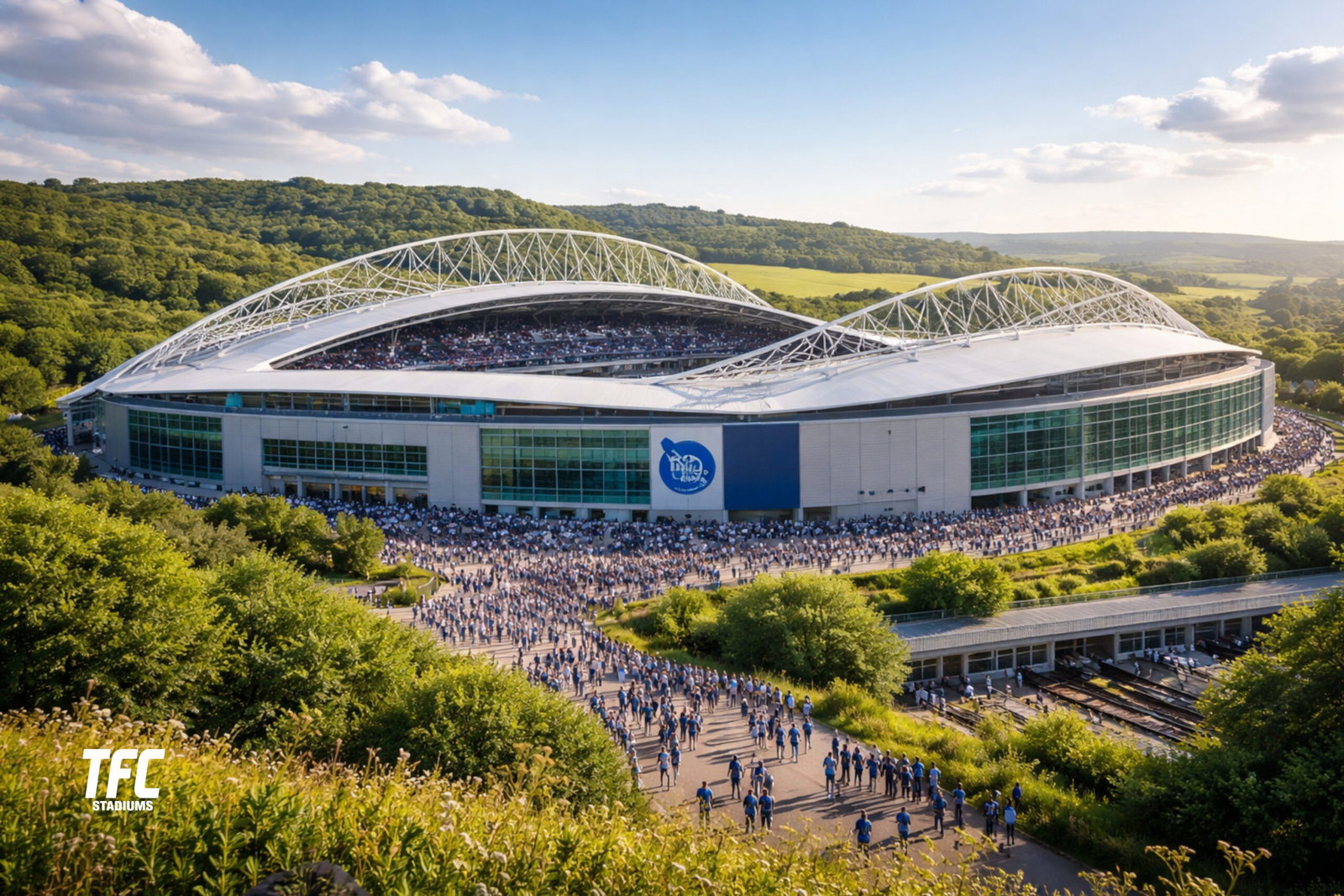
Most Premier League stadiums are hemmed in by roads, housing, or retail parks. The Amex sits differently. Tucked into the edge of the South Downs, it feels closer to a modern amphitheatre than a conventional football ground. From certain angles, the sweeping roofline mirrors the surrounding hills, which gives the stadium a sense of place rather than the dropped-in feel common to newer builds.
This setting is not just scenic. On clear days, the light pours into the bowl in a way that makes afternoon kick-offs feel unusually open and calm, at least until the home end finds its voice.
Designed for Football, Not Distraction
The Amex was built with football as the clear priority. Sightlines are clean, stands are steep without being uncomfortable, and the pitch feels close even from the upper tiers. There is no attempt to turn the ground into an all-purpose entertainment complex, which is refreshing.
Acoustically, the roof does a lot of heavy lifting. Noise stays in the bowl, and when Brighton are on the front foot, the stadium carries an intensity that surprises visiting fans who expect something more subdued from a coastal club.
A Long Journey Made Concrete
To understand the Amex, you have to understand what came before it. Brighton spent years without a permanent home, bouncing between grounds and playing in front of crowds that deserved better. The stadium is not just an upgrade, it is the physical proof of survival and progress.
That history gives matchdays an edge. There is pride here, but also memory. Supporters know exactly how fragile football infrastructure can be, and it shows in the way the ground is treated and defended as home turf.
Seamless Matchday Logistics
For a stadium located outside the city centre, the transport planning is unusually effective. Falmer railway station sits right next to the ground, and the flow of fans before and after matches is impressively smooth for a venue of this size.
This matters more than it sounds. A good stadium experience can unravel quickly if leaving feels like a chore. At the Amex, the journey back into Brighton or further afield feels managed rather than improvised.
Modern Without Feeling Cold
Many newer stadiums struggle with atmosphere because they feel corporate or sterile. The Amex avoids this by keeping its design restrained. The materials are modern, but not flashy. The concourses are functional, but not soulless. It feels like a football stadium first and a venue second.
That balance makes it adaptable. European nights, relegation scraps, and sunny early-season fixtures all feel at home here, which is harder to achieve than architects like to admit.
A Stadium That Reflects Its Club
Brighton & Hove Albion have built a reputation for patience, smart recruitment, and long-term planning. The Amex mirrors that philosophy. It is not the biggest ground in the league, nor the loudest by default, but it is one of the most coherent.
Everything about it makes sense when you look closely, from its position in the landscape to the way it serves its supporters. That coherence is what makes the Amex Stadium genuinely unique.
About the Author