The Allianz Arena has a habit of announcing itself long before you see the pitch. That glowing exterior feels almost alive, switching colours with an ease that still surprises first time visitors. There is engineering behind the magic, but the effect is so smooth that it becomes part of Munich’s matchday rhythm.
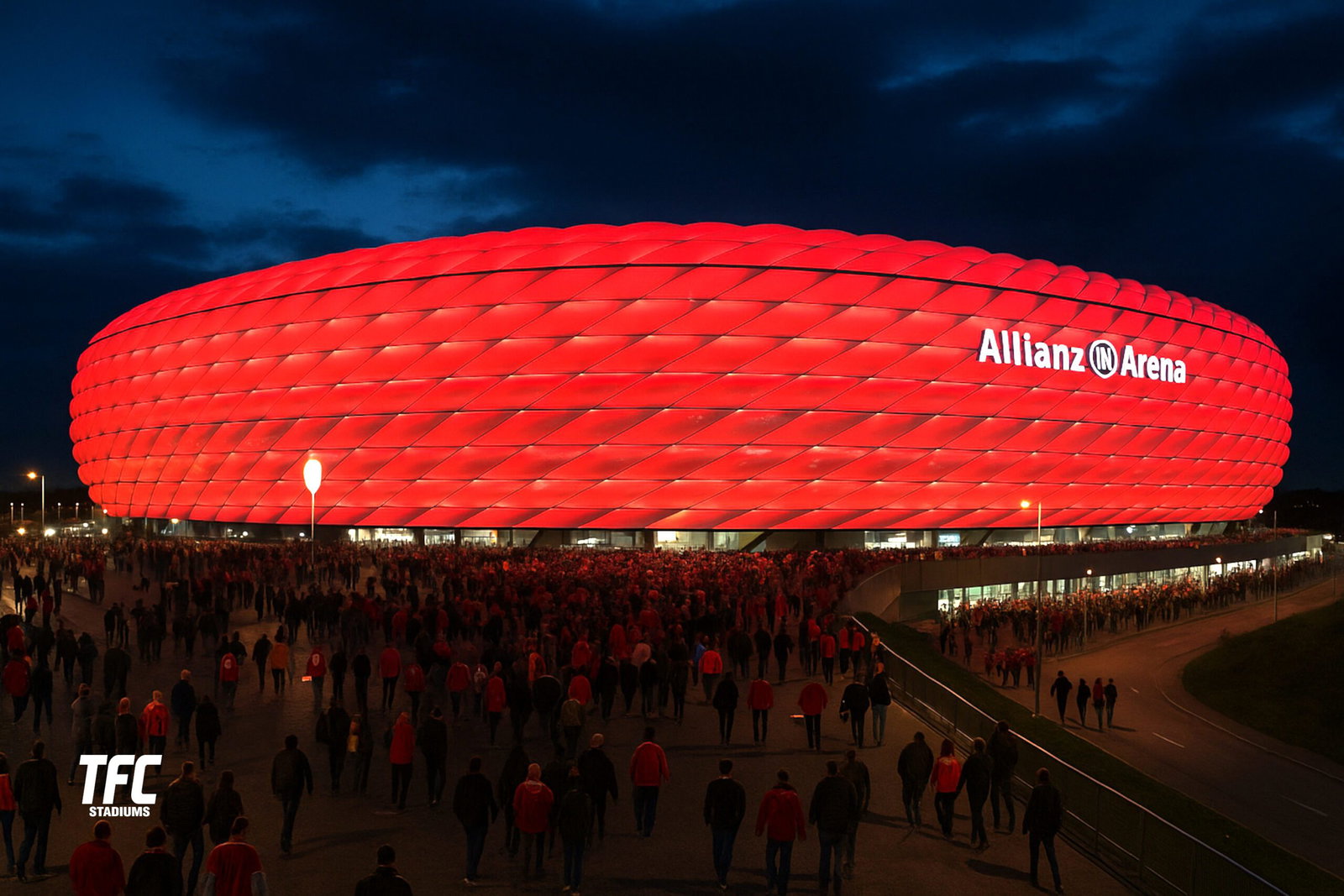
The stadium’s façade is made from hundreds of ETFE foil cushions that sit around the entire bowl. Each one can be lit from within, creating a surface that behaves like a giant programmable canvas. It is not just a case of flicking a switch. The system can set each cushion to a specific tone, giving designers near complete control of the building’s mood.
How the Lighting System Works
The technology started with fluorescent tubes when the stadium opened in 2005. That original system offered only a few preset colour states. After a major upgrade, the arena now uses high efficiency LEDs mounted behind the ETFE panels. These LEDs deliver stronger brightness, lower energy use and a level of control that was not possible before.
The LEDs can be adjusted through a central control platform that lets operators fine tune intensity, temperature and shade. They can light individual panels or whole sections, which means the stadium can shift between simple solid colours or more complex patterns. Because the LEDs sit behind the cushions, the colour spreads evenly without harsh hotspots.
When the Arena Changes Colour
The stadium’s default colours are linked to its two main tenants. Bayern Munich games turn the entire façade red, while 1860 Munich historically saw it glow blue. Neutral events use white, keeping things elegant and uncomplicated.
There are moments when the arena breaks from club colours. International fixtures, concerts and tournaments often bring their own colour schemes. The city occasionally lights it in support of public causes, though these tend to be carefully selected to avoid overuse.
On nights when several events follow each other, the colours shift in timed sequences. The transitions are smooth rather than abrupt, which gives the building a sense of calm movement. It is one of the rare stadiums where you can stand outside and feel that the architecture is performing as much as the teams inside.
Why the Colour Changes Matter
The Allianz Arena’s lighting has become part of Munich’s identity. Travellers recognise it from the motorway long before they reach the city. For Bayern fans it sets the mood on matchdays, glowing red like a signal that the night belongs to football. For visitors, it shows how a stadium can balance spectacle with clear engineering.
There is also something pleasing about how such a large structure relies on a surprisingly subtle trick. The foam like cushions are simple in form but highly effective when paired with modern lighting. What you get is not just colour for the sake of it, but a building that shifts character without losing its shape.
About the Author