1. A ground shaped by its surroundings
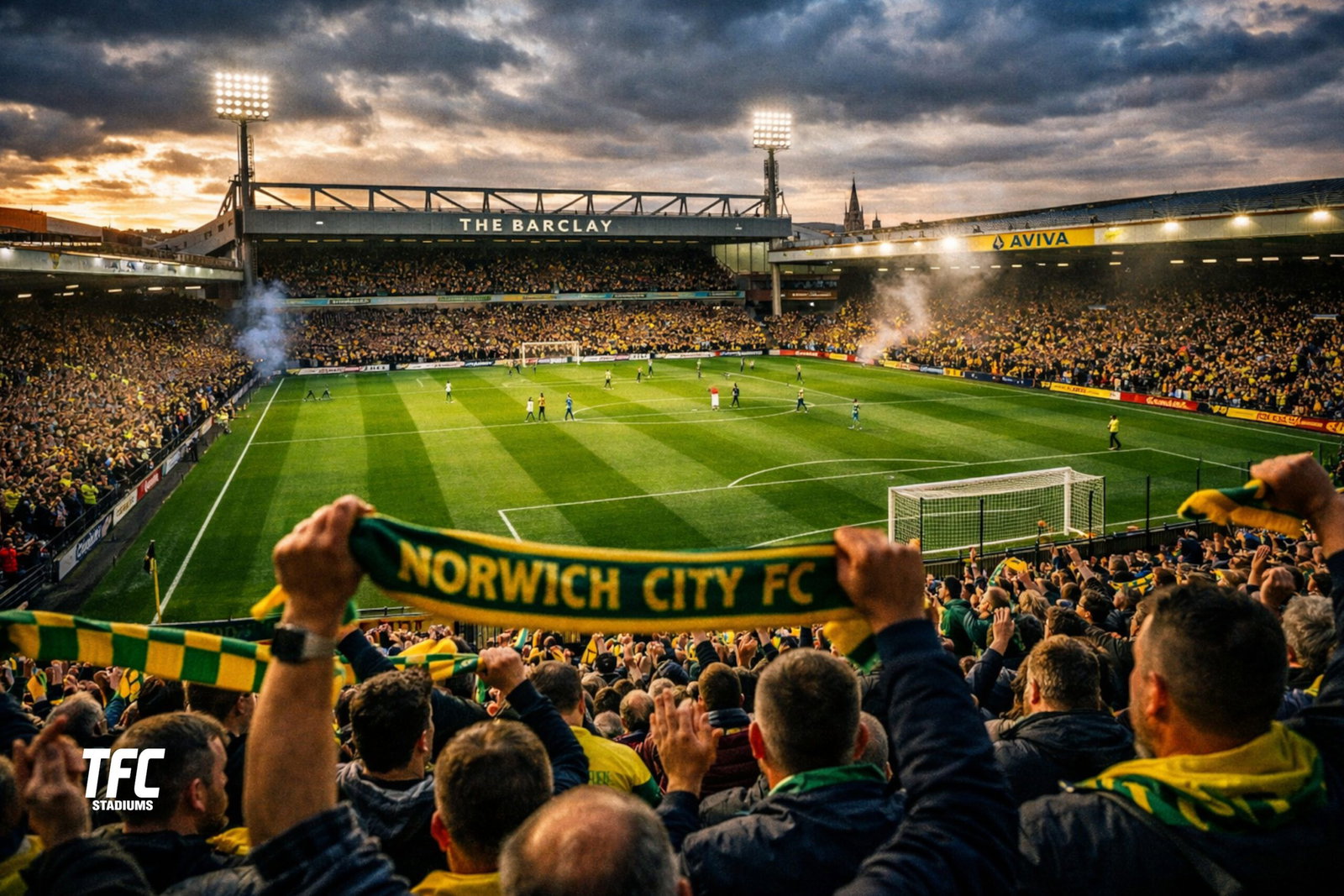
Carrow Road sits tight to the River Wensum, a location that has influenced everything from access routes to the compact feel inside the stadium. You notice it immediately on matchday. Streets funnel supporters straight towards the turnstiles, and the ground feels part of the city rather than dropped on its edge.
2. A capacity that keeps things close
With a capacity just over 27,000, Carrow Road stays intimate even when sold out. There are few wasted corners and very little distance between stands and pitch. That closeness is a big reason why visiting teams often talk about noise travelling sharply across the ground.
| Stand | Capacity (approx.) |
|---|---|
| The Barclay End | 9,000 |
| River End | 5,000 |
| City Stand | 4,500 |
| Regency Security Stand | 8,500 |
3. The Barclay sets the tone
The Barclay End is the emotional engine of the stadium. It has long been home to the loudest regulars and the quickest reactions. Early kick offs do not soften it much. When Norwich start fast, the Barclay usually does too.
4. A crowd that knows its football
Carrow Road crowds have a reputation for being vocal without being constant. There are moments of calm, followed by sharp bursts of noise when something matters. It reflects a fanbase that watches closely and reacts to patterns of play rather than chanting on autopilot.
5. Matchday routines that rarely change
Fans tend to arrive early, especially for league fixtures. Pubs along King Street and Thorpe Road fill steadily rather than in a last minute rush. Inside the ground, queues build well before kick off, and seats are taken earlier than at many modern stadiums.
6. Historic rivals still shape the mood
Fixtures against Ipswich Town remain the emotional high point, even in seasons when the clubs do not meet. When they do, the atmosphere tightens noticeably. Songs are sharper, tackles feel heavier, and the crowd stays engaged well beyond the final whistle.
Head to head snapshot: East Anglian Derby (league games)
| Result type | Norwich City | Ipswich Town |
|---|---|---|
| Wins | 59 | 44 |
| Draws | 44 | 44 |
| Goals scored | 206 | 186 |
7. Visiting giants feel the pressure
Carrow Road has produced some famous results against bigger clubs. The stadium does not overwhelm through size, but through concentration. When Norwich score first, the crowd tends to stay loud rather than celebratory, as if aware the job is not finished.
Selected home results vs major clubs
| Opponent | Competition | Result |
|---|---|---|
| Manchester United | Premier League | Norwich win |
| Manchester City | Premier League | Norwich win |
| Bayern Munich | UEFA Cup | Draw |
8. Sightlines that reward older design
Despite modern upgrades, Carrow Road retains the advantages of a traditional layout. Sightlines are clean, pillars are minimal, and most seats feel closer to the pitch than the raw capacity suggests. It is a ground where you watch details rather than just movement.
9. Noise behaves differently here
Because of the enclosed corners and stand height, sound tends to roll rather than echo. Chants pick up quickly and fade fast, which keeps the atmosphere dynamic. A single incident can flip the volume in seconds, for better or worse.
10. A matchday that feels local
Above all, Carrow Road feels like it belongs to Norwich rather than football tourism. You see the same faces, hear the same arguments, and sense a shared memory of good and bad seasons. That continuity gives matchdays a grounded, lived in quality.
Carrow Road at a glance
| Detail | Data |
|---|---|
| Home club | Norwich City |
| Opened | 1935 |
| Capacity | 27,244 |
| Record attendance | 43,984 |
| Location | Norwich city centre |
Carrow Road does not try to impress with scale or spectacle. Its matchdays are defined by familiarity, proximity, and a crowd that reacts like it has seen it all before. That combination makes it one of the more quietly distinctive grounds in English football.
About the Author