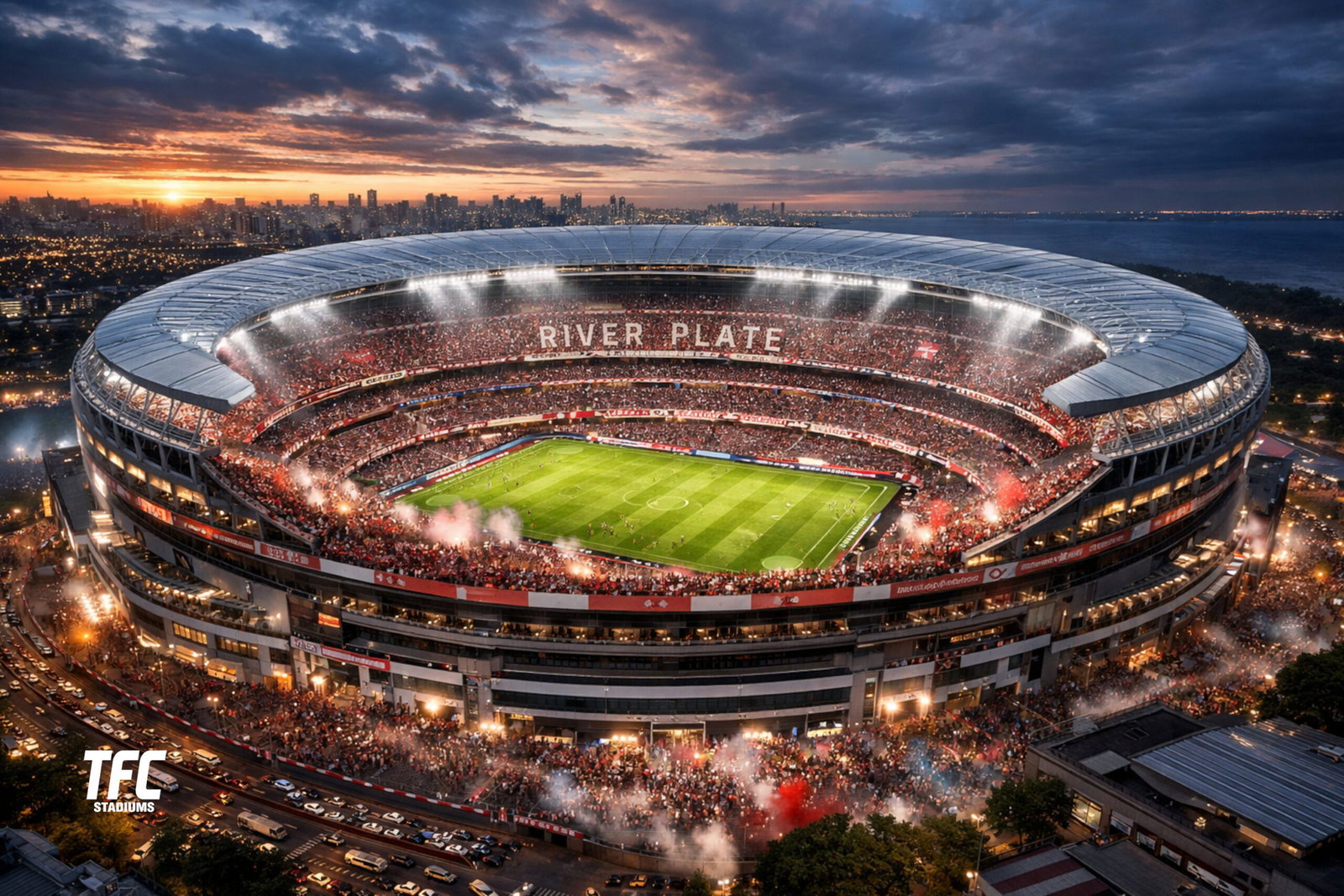
The home of Club Atlético River Plate does not whisper for attention. Estadio Monumental announces itself, loudly, repeatedly, and with absolute certainty that it matters more than whatever else you had planned that evening.
It is South America’s largest football stadium, Argentina’s unofficial national theatre, and a place where football feels less like entertainment and more like civic duty.
Location and Setting
The Monumental sits in the Núñez district of Buenos Aires, bordered by calm streets that feel wildly unprepared for what pours out after full time. The exterior is functional, almost modest. Inside, it becomes a concrete amplifier for obsession.
You can hear goals echo across the neighbourhood. Locals barely look up anymore.
Capacity and Layout
Following recent redevelopment, official capacity sits at just over 84,000, comfortably the largest in South America. The continuous bowl design pulls supporters close to the pitch, while the upper tiers rise steeply enough to make vertigo a real concern for newcomers.
Sightlines are clean. Comfort is secondary. Atmosphere is the main event.
History and Iconic Moments
Opened in 1938, the Monumental has hosted nearly every meaningful chapter of Argentine football. The 1978 World Cup Final remains its most famous night, but River Plate’s own history fills the rest of the calendar.
League titles, Libertadores triumphs, unforgettable Superclásicos, and the steady churn of legends have turned this ground into something closer to folklore than infrastructure.
Players do not just debut here. They are tested.
Recent Redevelopment and Modernisation
River Plate modernised without gutting the soul of the stadium. The lower bowl was rebuilt, seating brought closer to the pitch, circulation improved, and facilities dragged into the 21st century.
The upgrades prioritised capacity and acoustics rather than luxury excess. This is not a stadium chasing VIP selfies. It is built to be hostile, loud, and unapologetically partisan.
Expansion Plans, 100,000 Seats and a Roof
River Plate are not done thinking big. According to detailed plans reported by StadiumDB, the club is preparing a second major transformation that would push the Monumental toward a staggering 100,000 seat capacity, alongside the addition of a full roof structure .
The proposal includes:
- Further expansion of the upper tiers to maximise vertical capacity
- A continuous roof designed to amplify noise and improve weather protection
- Structural reinforcement to future proof the stadium for decades
If completed, the Monumental would become one of the largest football stadiums in the world, not just South America. More importantly, the roof would trap sound inside the bowl, which should concern visiting teams and possibly nearby air traffic.
River’s leadership has framed the project as both a sporting and commercial necessity, aimed at increasing matchday revenue, hosting more international events, and cementing the club’s status as a global football institution rather than a regional giant.
Timelines remain flexible, funding is complex, and construction will likely be phased to avoid closing the stadium entirely. Still, the ambition is very real, and very River Plate.
Matchday Atmosphere
The Monumental does not warm up. It detonates.
Singing begins long before kick off and rarely fades. Goals feel seismic. Opponents talk about pressure before the ball even moves. This is not crowd noise. It is organised emotional overload.
You leave with a hoarse throat and a strange sense of having participated in something bigger than a football match.
Comparisons With Other Iconic Stadiums
River’s rivals play at La Bombonera, which is louder per seat but far smaller. The Bombonera punches. The Monumental overwhelms through scale.
Brazil’s Maracanã shares the Monumental’s history but lost some edge in modernisation. Núñez kept its teeth.
Barcelona’s Camp Nou holds more people, but the Monumental feels more intense. Camp Nou observes. River demands.
And yes, as a Californian, I will mention SoFi Stadium. SoFi is an architectural flex. The Monumental is emotional warfare. Different sports, different cultures, different priorities.
Cultural Importance
This stadium is more than River Plate’s home. It is Argentina’s default venue for moments that matter, from national team fixtures to symbolic matches that carry political and cultural weight.
When something important happens in Argentine football, chances are it happens here.
TFC Takeaway
The Estadio Monumental is imperfect, ageing in places, chaotic in others. That is precisely why it works.
With plans pushing toward 100,000 seats and a roof to trap every ounce of sound, River Plate are doubling down on what this stadium does best. Intimidation through scale and noise.
If football is supposed to feel overwhelming, the Monumental remains the gold standard.
About the Author