Few stadiums capture the imagination quite like the Caesars Superdome in New Orleans. Rising from the city’s skyline like a metallic crown, it’s more than just a sports venue. It’s a story of engineering brilliance, architectural daring, and civic determination. From its unique roof structure to its survival through Hurricane Katrina, the Superdome stands as a testament to human ingenuity and Louisiana’s resilience.
Vision and Design
When the project was first proposed in the 1960s, it was nothing short of audacious. Engineers and architects were asked to create the largest fixed-dome structure ever built. At the time, retractable roofs were not yet practical, so the challenge was to design a dome that could cover an entire stadium without interior supports blocking the view.
The winning concept came from architect Nathaniel C. Curtis Jr., who envisioned a massive, open interior capped by a shallow steel dome spanning 680 feet. The structure would not only house football but also basketball, concerts, and conventions. The design was meant to project confidence in a modern New Orleans, combining scale with adaptability.
The Dome That Defined Modern Stadium Engineering
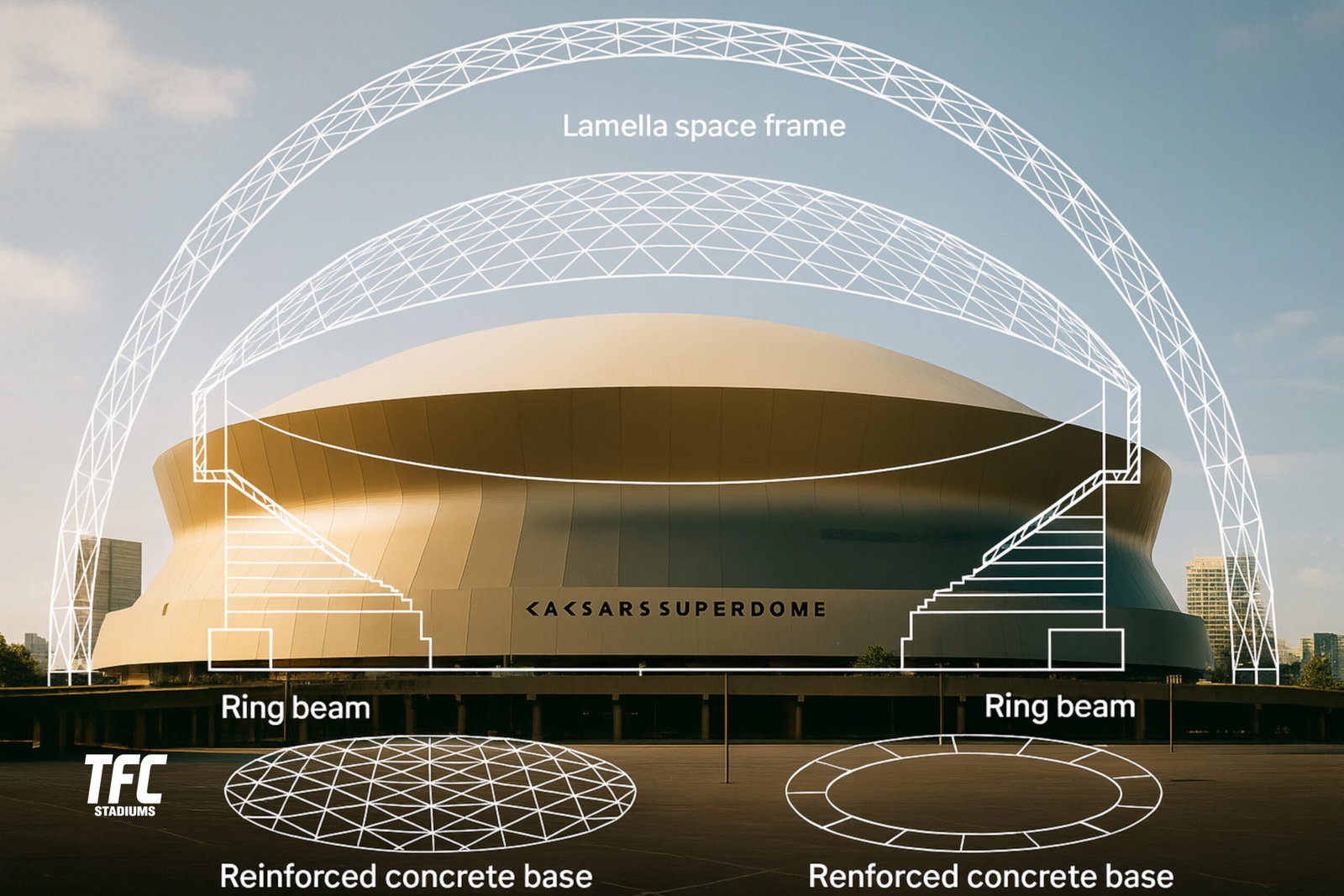
The Superdome’s roof remains one of the most impressive feats of structural engineering. It’s made up of a lamella space frame—an intricate lattice of steel triangles weighing over 9,000 tons. This structure distributes weight evenly and allows for an unobstructed interior space.
The exterior shell, covered in anodised aluminium panels, reflects sunlight and resists corrosion from the Gulf’s humid climate. Beneath it lies a web of tensioned cables, allowing the dome to flex under stress, an innovation that proved critical during high winds and storms.
The entire roof is supported by a ring beam that circles the building’s perimeter. This design eliminated the need for internal columns, ensuring perfect sightlines from every seat.
Built to Withstand the Elements
Louisiana’s weather demanded durability. Engineers designed the Superdome to endure hurricane-force winds of up to 200 mph. The roof’s curved shape and smooth aluminium skin reduce drag, while the reinforced concrete base anchors it securely to the ground.
This design was tested dramatically during Hurricane Katrina in 2005. Though parts of the roof were damaged, the Superdome remained structurally sound, sheltering thousands of residents. Its performance under those conditions validated decades of engineering foresight.
The Scale of Construction
The project began in 1971 and took four years to complete, at a cost of $134 million (roughly $700 million today). More than 12,000 tons of structural steel, 169,000 cubic yards of concrete, and 1,500 workers were used in its construction.
At 273 feet high and covering 13 acres, the Superdome dwarfed anything built before it. When it opened in 1975, it was the world’s largest indoor arena, capable of seating over 70,000 fans.
Innovation Through Renovation
Following Hurricane Katrina, the Superdome underwent a $336 million renovation. Engineers reinforced the roof, upgraded drainage systems, and replaced over 400,000 square feet of exterior panels. The interior was redesigned for comfort and acoustics, allowing it to transition seamlessly between NFL games, concerts, and conventions.
A later upgrade introduced LED lighting, advanced energy systems, and expanded hospitality suites, ensuring the Superdome remains competitive in the modern era of smart stadiums.
Legacy and Symbolism
Beyond its engineering, the Superdome has become a cultural icon. It’s hosted seven Super Bowls, multiple Final Fours, concerts by legends from The Rolling Stones to Beyoncé, and pivotal civic moments for New Orleans.
Its story mirrors that of the city itself: bold, resilient, and forever reinventing. The Superdome stands not only as a feat of human engineering but as a monument to endurance and unity.
TFC Takeaway
The Caesars Superdome was an act of engineering vision. Combining architectural artistry with structural innovation, it became a global model for domed stadiums. Today, its silhouette remains one of the most recognisable in sport, a symbol of how far engineering can go when ambition meets necessity.
About the Author